
How to Unclog a Bathtub Drain Yourself: Hair, Rags, Foreign Objects and Stubborn Clogs
A clogged bathtub drain seems like it should be one of the cheapest problems in the house. You buy a five-dollar plastic drain tool, pull out a disgusting wad of hair, rinse the tub and carry on with your day. Unfortunately, that simple plan falls apart when the tool goes only a few inches into the drain, stops dead, and the bathtub still refuses to empty. Suddenly, something that looked like a ten-minute DIY job starts looking suspiciously like another expensive plumbing bill.
That is roughly what happened at a friend’s house recently. We have good reason to suspect that one of those small shower cloths—basically a thin washcloth used in the shower—may have disappeared down the bathtub drain. The suspicion is particularly strong because a similar cloth had already become stuck in one of their bathroom sinks, eventually resulting in a plumber being called and a bill of roughly $500. Naturally, I would prefer not to repeat that experience if there is a realistic DIY solution.
I tried one of those inexpensive flexible retrieval tools with a little claw at the end that extends roughly three feet. It seemed like exactly the right tool for the job: feed it into the drain, grab the cloth and pull it back out. Instead, it travelled only a short distance into the bathtub drain before hitting something and refusing to go any farther. At first, that makes it feel as though the blockage must be sitting right there, but there is another explanation, and understanding it changes the entire approach to unclogging a bathtub.
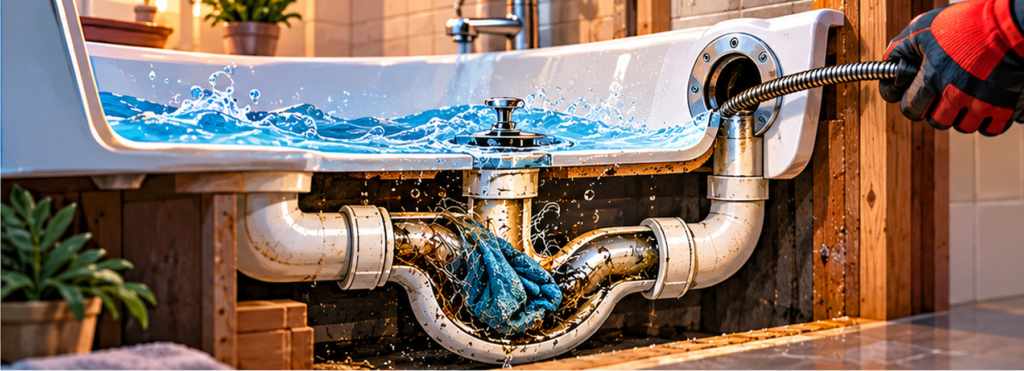
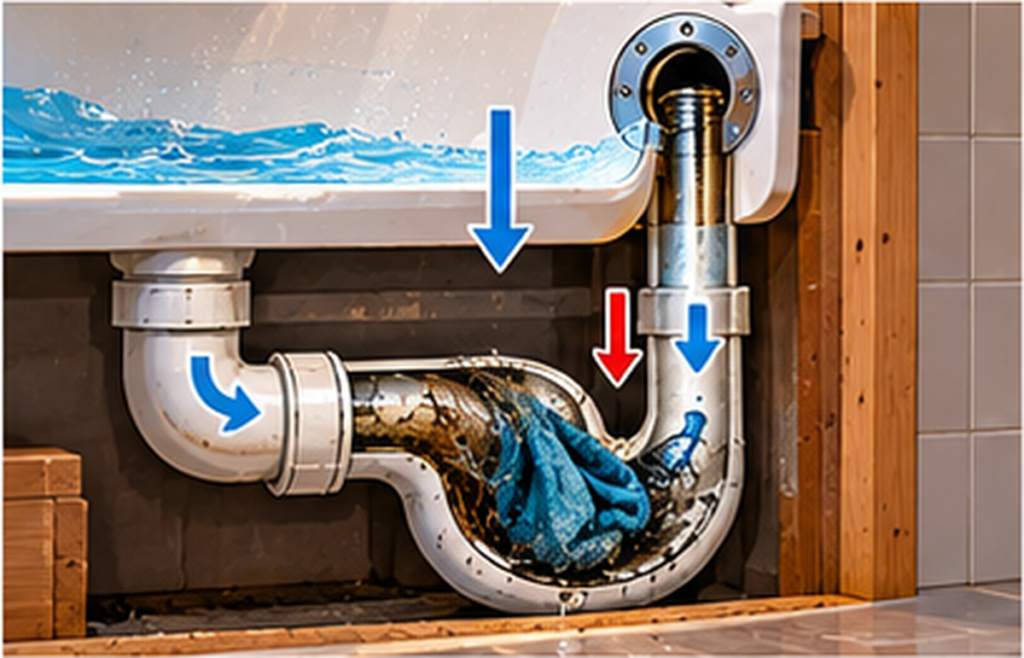
The pipe underneath a bathtub does not simply travel straight down from the drain. There are fittings, bends, a waste-and-overflow assembly and eventually a trap hidden underneath and behind the tub. That means a cheap grabber can hit part of the plumbing long before it reaches the actual obstruction. Once you understand that, the job becomes less about forcing the tool harder and more about choosing the correct access point and the correct tool.

Tools and Supplies You May Need
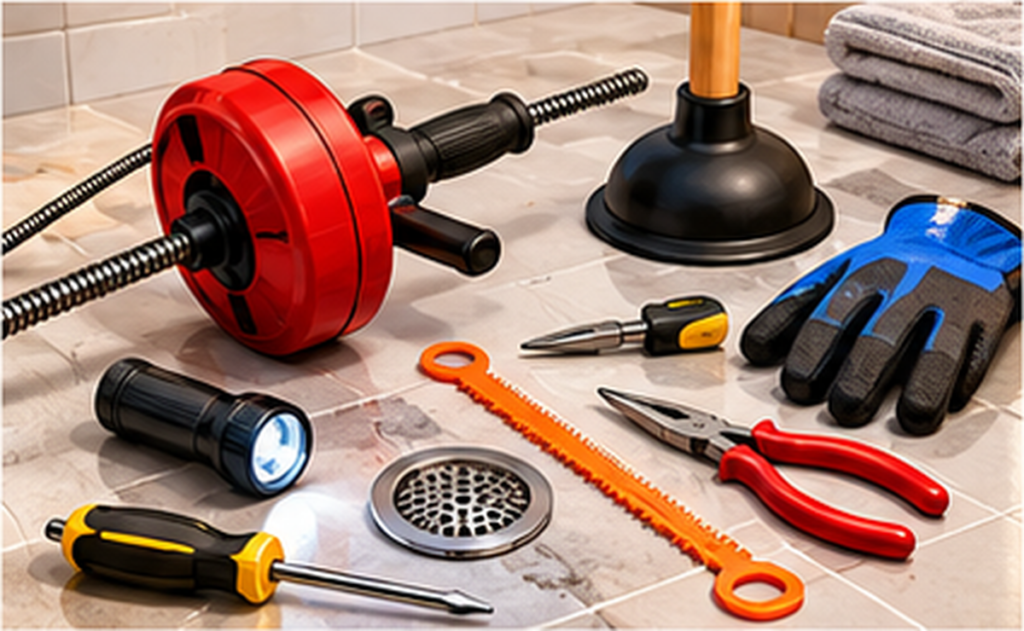
You do not need a plumber’s truck full of equipment to tackle most bathtub clogs. In fact, many jobs can be handled with a handful of inexpensive tools you may already own. The one piece of equipment worth buying if the clog is deeper than the drain opening is a proper flexible drum auger, because that is what gives you enough reach and flexibility to navigate the hidden bends in the bathtub plumbing.
Gather as many of the following items as you have before starting:
- Rubber or nitrile gloves
- Bright flashlight or headlamp
- Screwdriver set
- Needle-nose pliers
- Plastic barbed hair-removal tool
- Flexible claw-style retrieval tool
- Standard cup plunger
- 1/4-inch × 25-foot drum auger or drain snake
- Bucket
- Old towels or rags
- Small container or cup for removing standing water
- Wet/dry shop vacuum, optional
- Drain screen or hair catcher for prevention afterward
If you suspect a washcloth, rag or other foreign object, the 1/4-inch × 25-foot drum auger is the most important upgrade from the little plastic or claw-style tools sold near the checkout aisle. Those small tools are excellent for debris sitting just below the drain, but they often cannot negotiate the bends farther inside the plumbing. A flexible auger can be fed through the bathtub overflow opening and worked toward the trap, giving you a much better chance of actually reaching the obstruction.
You do not need to buy everything on this list before starting. Begin with the basic inspection tools, then move to the auger only if the easy methods fail. The whole point of this troubleshooting process is to escalate gradually rather than spending money blindly.
Why Your Drain Tool May Stop After Only a Few Inches
A bathtub’s plumbing is hidden, so it is easy to picture the drain as a vertical pipe underneath the hole. In reality, the drain opening in the bottom of the tub connects to a short section known as the drain shoe. That plumbing travels sideways toward a waste-and-overflow fitting, where it meets the pipe coming down from the overflow opening higher on the bathtub wall. From there, the water travels toward a trap and eventually into the home’s drainage system.
Depending on the tub, there may also be stopper hardware, crossbars, linkage or other components occupying space inside the assembly. What looks from above like a simple hole can therefore contain several turns before you ever reach the actual drain line. This explains why a three-foot grabber can be flexible in your hand yet still refuse to make its way through the bathtub plumbing. It may not be hitting your clog at all; it may simply be hitting the side of a fitting or reaching a bend that the tool was never designed to negotiate.
Trying to force it harder is unlikely to solve that problem. At best, you keep hitting the same fitting over and over again. At worst, you manage to wedge your tool inside the plumbing and create a second problem. The solution is to stop thinking only about the drain hole at the bottom of the tub, because there is another entrance that is often much better for clearing a deeper blockage.
The Bathtub Overflow Is Your Secret Access Point
Look at the wall of your bathtub underneath the faucet. Several inches above the bottom of the tub, there should usually be a round plate with one or two screws. Some have a lever attached, while others are simply decorative covers. That is your bathtub overflow, and it is much more useful during drain cleaning than many homeowners realize.
Its obvious purpose is to allow water to escape if the tub gets too full, but it also provides extremely useful access to the drainage system. Bath waste-and-overflow manufacturer Oatey specifically explains that these systems can be cleaned by removing the overflow faceplate and any attached internal linkage, then feeding a drain cable through the overflow opening and down toward the trap. You can read more about the assembly here: Oatey bath waste and overflow information.
This is the part I wish more DIY drain-cleaning instructions emphasized because it answers the obvious question: how on earth is a drain snake supposed to make those sharp turns? Part of the answer is that a proper drain auger is considerably more flexible than a cheap retrieval claw. The other part is that you are giving it a better route by feeding it down through the overflow pipe toward the trap instead of trying to force it sideways through the bottom drain opening.
First, Decide What Kind of Clog You Are Dealing With
Not every clogged bathtub should be treated the same way. One of the biggest mistakes homeowners make is finding a generic drain-cleaning method online and applying it to every blockage regardless of what is actually inside the pipe. A bathtub that has been getting progressively slower for months probably has a very different problem from a bathtub that suddenly stopped draining after a washcloth disappeared.
Hair, soap residue, oils and other bathroom grime usually accumulate gradually. Water begins taking a little longer to disappear, then starts pooling around your feet during a shower, and eventually the tub becomes seriously restricted. These clogs can often be pulled apart, snagged with a hair tool or broken up with a drain auger. A foreign object is different because a washcloth, shower cloth, plastic cap, piece of packaging or small toy does not simply dissolve because you pour something into the drain.
A foreign object can fold itself into the pipe, partially block water and then begin collecting hair and soap around it. If you suspect something physically entered the drain, your strategy should change from “destroy the clog” to “retrieve the object.” That simple difference matters because repeatedly trying to punch through a cloth may just push it deeper into the plumbing.
A few clues can help you decide what you are probably dealing with:
- Gradually worsening drainage usually points toward hair, soap and normal buildup.
- A sudden blockage is more suspicious for a foreign object.
- A tool that comes back covered in hair is probably reaching at least part of the clog.
- A tool that stops at exactly the same shallow depth every time may be hitting plumbing rather than debris.
- Several fixtures backing up at once suggests a larger branch-drain or main-drain problem rather than a simple bathtub clog.
- A tub that drains normally one day and barely drains immediately after something disappears deserves to be treated as a possible foreign-object blockage.
Knowing the difference can save you from making the situation worse.
Step 1: Remove the Standing Water
If the bathtub contains several inches of dirty water, get most of it out before doing anything else. You can scoop it into a bucket with a container, siphon it if appropriate, or use a wet/dry shop vacuum if you already have one available. Removing the water makes it easier to see the drain, keeps your tools cleaner and reduces the amount of mess you create while working.
Do not use a shop vacuum if someone has already poured corrosive drain cleaner into the tub. You do not want caustic liquid splashing through a vacuum hose, getting onto your skin or contaminating the machine. Once the water level is low, clean the area around the drain enough that you can see what you are doing, put on gloves and use a bright flashlight. Plumbing repairs become considerably easier when you can actually see the hardware rather than working through a pool of dirty water.
Step 2: Remove the Stopper and Inspect the Easy Stuff First
Before taking anything else apart, inspect the drain opening itself. Many bathtub clogs are surprisingly close to the surface, especially when the problem is ordinary hair accumulation. Depending on the tub, you might have a toe-touch stopper, lift-and-turn stopper, push-pull stopper, trip-lever system or another design. Remove only the parts that are designed to come out easily rather than immediately unscrewing the entire metal drain flange from the bathtub.
Once the stopper is out of the way, shine your flashlight into the drain. Hair often wraps around the crossbars immediately beneath the opening, and a plastic barbed hair-removal strip, needle-nose pliers or small flexible claw can be excellent here. Pull out everything you can reach, no matter how unpleasant it looks, and then run a small amount of water to see whether drainage improves.
Do not immediately fill the bathtub. Test the system gradually so you can tell whether the blockage is actually gone and whether anything you disturbed is leaking. If you remove a large wad of hair and the tub suddenly drains properly, you may already be finished. If your little retrieval tool keeps stopping several inches down with nothing attached to it, it is time to move on.
Why I Would Not Keep Forcing the $5 Grabber
A cheap flexible claw is useful, but it is not really a drain snake. Its purpose is retrieving something reasonably close to the opening, not navigating several metres of residential plumbing. That distinction matters because a tool can be flexible enough to bend in your hand while still being far too stiff to follow the tight route through a bathtub drain shoe and trap.
If the tool stops at the same point repeatedly, pushing harder does not prove the clog is stubborn. You may simply be pressing the tool against the wall of the drain shoe or another fitting. This is particularly important if you think a cloth is somewhere farther into the system, because the last thing you want to do is spend half an hour fighting a tool that physically cannot reach the obstruction.
Keep the little grabber because it is still useful for shallow debris, jewellery and objects close to the opening. Just recognize when its job is finished. Once it repeatedly stops at the same shallow point, the smarter move is to change your access point and upgrade to a real drain auger.
Step 3: Plunge an Ordinary Clog—But Think Twice With a Rag
A plunger can work very well on an ordinary bathtub blockage, but there is one detail that makes all the difference: you must deal with the overflow opening. If the overflow remains open, some of the pressure created by your plunger can simply escape through it. Instead of forcing water back and forth against the clog, you are partially pumping air through another hole.
For a typical hair-and-soap blockage, cover the overflow opening tightly with a wet rag or remove the overflow cover and seal the opening. Put enough water in the tub to cover the plunger cup, make a solid seal over the drain and plunge firmly several times. Then test the drain with a small amount of water and see whether the flow has improved.
However, I would approach this differently if I had strong reason to believe an actual washcloth or other solid object was inside the pipe. A plunger may move the object, but you do not have much control over where it goes. You might bring it closer, but you might also drive it deeper into the branch piping, so if I knew somebody had dropped a cloth into the tub and the drain clogged immediately afterward, I would lean toward mechanical retrieval rather than aggressive plunging.
Step 4: Remove the Overflow Cover
Now we reach the step that makes a stubborn bathtub clog much more manageable. Place an old towel in the bathtub before removing anything because this protects the surface and prevents screws from bouncing straight into the open drain. Remove the screws holding the overflow plate to the bathtub wall, then gently pull the cover toward you.
If there is simply a plate covering the opening, it may come straight off. If the tub has a trip-lever stopper, the plate may be attached to a metal linkage extending down inside the overflow tube. Pull slowly rather than yanking the assembly, and if linkage comes out with the plate, pay close attention to its orientation. Taking a quick phone picture before fully removing it is one of those tiny DIY habits that can save a surprising amount of frustration during reassembly.
Once the plate and any necessary linkage are out of the way, look into the opening with your flashlight. You now have a much better entrance into the bathtub drain system. Instead of fighting through the bottom drain, you can follow the overflow pipe downward toward the trap.
Step 5: Buy the Right Kind of Drain Auger
If you have reached this stage and still have a blockage, I would stop buying little plastic gadgets and get a proper drum auger. For a bathtub, shower or bathroom sink, a very useful homeowner size is a 1/4-inch cable approximately 25 feet long. That gives you a flexible cable capable of making plumbing bends while providing enough reach to travel well beyond the immediate bathtub assembly.
You do not need a massive sewer machine, and you do not need to spend hundreds of dollars. Home Depot Canada, for example, carries manual 1/4-inch × 25-foot drum augers intended for sinks, showers and bathtub drains. You can see the general type of tool here: Home Depot Canada drain augers.
There are powered models available too, but for this particular job I would actually prefer beginning with a manual drum auger. A hand-operated tool gives you much better feedback about what the cable is touching, which matters when you are trying to determine whether you have encountered a bend, a wad of hair or an actual piece of fabric. At minimum, I would bring a 1/4-inch × 25-foot drum auger, gloves, screwdriver, needle-nose pliers, flashlight, bucket, several old towels, a plastic drain-hair tool and the small retrieval claw you already own.
Step 6: Feed the Auger Through the Overflow
Pull a short length of cable from the auger drum and guide the tip into the overflow opening. Keep the drum fairly close to the bathtub wall because you do not want several feet of loose cable whipping around between the drum and the pipe. Begin feeding the cable downward while slowly rotating the drum clockwise.
Do not shove the cable. This is where its construction does the work for you, because a drain auger is essentially a long, tightly wound flexible spring. When the tip reaches a bend, rotating the cable while applying modest forward pressure encourages it to follow the shape of the pipe rather than simply jam against the wall.
You may feed several feet easily and then suddenly meet resistance. That does not automatically mean you found the clog, so retract the cable a few inches, rotate it again and gently advance. If it starts moving again, you probably just negotiated a fitting or the trap. If it repeatedly reaches the same deeper location and the resistance feels softer, springier or more grabby, you may finally be contacting the obstruction.
What Does a Plumbing Bend Feel Like Compared With a Clog?
Nobody can perfectly describe this because every pipe feels a little different through a steel cable, but there are some patterns worth recognizing. A hard plumbing turn often feels like a sudden stop, almost as if the tip has hit a wall. When you rotate the cable, pull back slightly and change the pressure, however, the tip may eventually find the opening and continue forward.
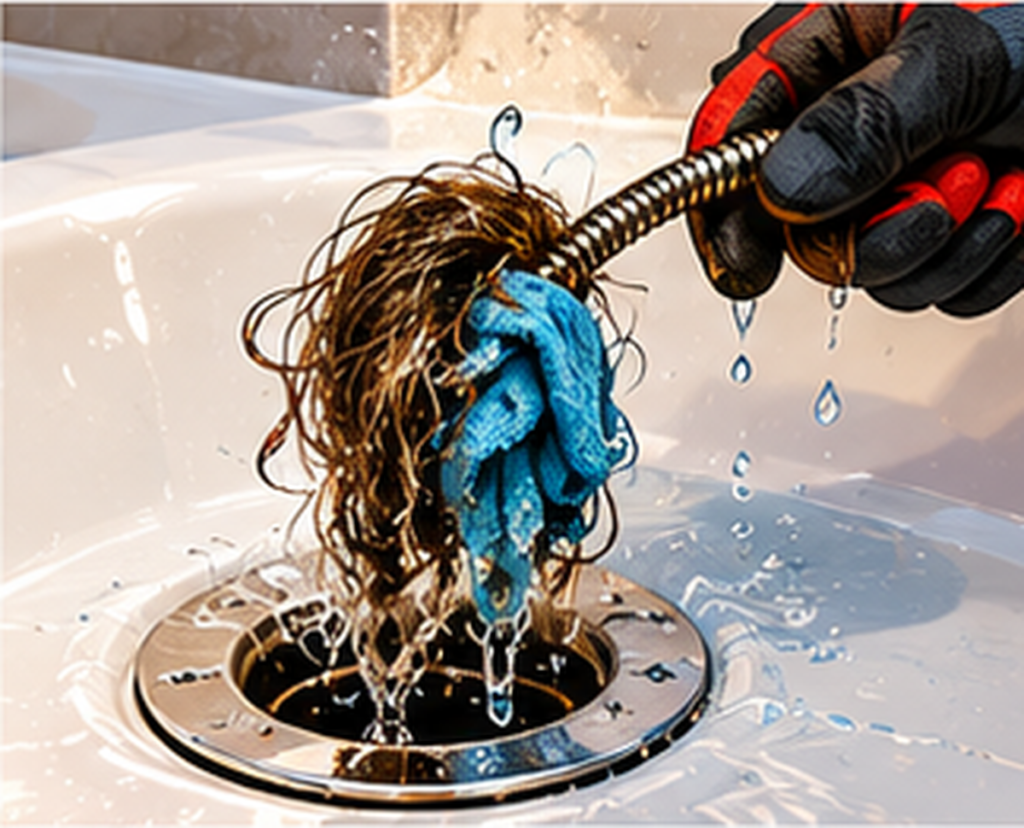
Hair usually feels softer and more irregular. The cable may begin advancing slowly while offering increasing resistance, and you may feel the tip chewing its way through material. When you pull the auger out, you may find hair wrapped around the cable or caught on the tip.
Fabric can feel stranger. A cloth may offer spongy resistance, and you might advance slightly, pull backward and feel something following the cable. You could also feel the cable suddenly pass through the object if the auger pierces the fabric, which is exactly why you should not turn this into a contest of strength. If your goal is retrieving a washcloth, breaking through it is not necessarily success.
Step 7: If You Suspect a Rag, Slow Everything Down
This is the most important section for the situation that inspired this article. Suppose somebody tells you that a small washcloth probably entered the drain, and your auger reaches an obstruction. Your natural instinct might be to crank harder until the cable punches through, but that is precisely what I would avoid.
Instead, rotate slowly while applying just enough forward pressure for the auger tip to work into the material. Then begin retracting the cable carefully. If the obstruction has become entangled with the cable, you may feel increased drag as you pull, and that is exactly what you want.
Keep turning the cable gently as you withdraw it rather than yanking it straight backward. Your goal is to persuade the cloth to come back through the plumbing in the same direction it entered. When the auger comes out, inspect the end carefully because hair wrapped around the cable tells you that you are reaching debris, while fabric fibres may tell you that you have reached the suspected cloth even if you have not yet removed the entire thing.
Clean the cable and repeat if necessary. Several gentle retrieval attempts are much preferable to one violent attempt that pushes the cloth another ten feet down the line. Patience is more useful than force here.
What If the Auger Goes Through but the Tub Is Still Clogged?
If you can feed a substantial amount of cable through the overflow but drainage barely improves, you need to reconsider what is happening. You may have punched through the centre of a soft obstruction without removing it, which can allow a little water to pass temporarily before the material settles back into place. You may also be dealing with buildup farther down the branch drain rather than one concentrated blockage.
Retract the auger and examine whatever it brings back. Then run it through again while deliberately trying to engage the material instead of simply reaching maximum distance. If you repeatedly pull out substantial amounts of hair, continue until the cable starts returning relatively clean. If you repeatedly find fabric fibres, you now have evidence supporting the washcloth theory.
If you get absolutely nothing and several fixtures in the bathroom are also draining poorly, the blockage may be farther downstream than the bathtub itself. At that point, the problem is no longer behaving like a simple tub clog and should be treated differently.
Can a Wet/Dry Vacuum Pull Out a Washcloth?
Possibly. A wet/dry shop vacuum can create substantial suction, and in the right circumstances it may pull loose material toward the drain opening. It is not guaranteed to retrieve something that has travelled through the trap, but if you already own the vacuum, it may be worth trying before cutting anything apart.
Remove the standing water first, seal the vacuum hose as tightly as possible around the drain opening and seal the overflow opening so air is not simply being sucked through there. Then use the vacuum in wet mode and listen carefully. If you hear the obstruction moving or the vacuum suddenly pulls something into the hose, stop and investigate.
There is one major exception: do not do this if chemical drain cleaner has been poured into the system. A shop vacuum is not where you want corrosive drain chemicals ending up, and the splash risk is not worth it.
Should You Use Liquid Drain Cleaner?
For a suspected washcloth, I would skip it completely. Drain cleaner cannot magically dissolve a piece of fabric lodged in your plumbing. Even if it removes some hair and organic buildup around the cloth, the underlying foreign object remains.
Now you have the same obstruction plus a pipe full of potentially corrosive chemical that you are about to open, plunge or snake. That is worse, not better. Even with an ordinary hair clog, I prefer mechanical removal whenever practical because it physically removes material from the system rather than relying on increasingly aggressive chemicals.
If drain cleaner has already been used, read the product’s instructions before doing anything else and protect yourself from splashing. Never mix different drain-cleaning chemicals together, because incompatible cleaners can create dangerous reactions.
What About Baking Soda and Vinegar?
This is another internet favourite. Pour baking soda down the drain, add vinegar, watch everything fizz dramatically and feel like chemistry is solving your plumbing problem. The reaction certainly looks impressive, but a bubbling drain is not proof that a serious blockage is disappearing.
For light residue and odour control, the combination may be harmless enough in many situations. For a dense wad of hair or a folded washcloth buried inside a trap, expectations should be much lower. If a physical object is inside your plumbing, you ultimately need a physical solution, which usually means pulling it out.
Step 8: Look for an Access Panel
If the auger repeatedly hits what appears to be the same obstruction but cannot retrieve it, the next question is whether you can physically access the bathtub plumbing. Check the room behind the faucet end of the tub because sometimes the opposite side of that wall is a closet, hallway or utility area containing a removable access panel. In other homes, bathtub plumbing may be visible from an unfinished basement ceiling beneath the bathroom.
An access panel can be extremely useful because you can finally see what the hidden plumbing actually looks like. You may discover modern ABS or PVC pipe, older metal plumbing, a different trap configuration than expected or even signs of leakage that were invisible from inside the bathroom. Simply being able to see the piping can make the next decision much easier.
Do not start cutting plumbing simply because you can see it. Understanding what you have does not mean you need to dismantle it. The goal is to determine whether the obstruction can be reached safely or whether you are approaching the point where professional plumbing experience becomes worthwhile.
Be Careful With Older Plumbing
Newer plastic drainage systems can usually tolerate careful snaking without much drama, but older plumbing deserves more respect. Cast iron can corrode internally, galvanized drain piping can become heavily restricted, and old brass waste-and-overflow assemblies can become fragile with age. Some older homes may also contain drum traps or unusual configurations that do not behave like the modern P-trap diagrams commonly shown online.
If your cable repeatedly stops in old plumbing and additional force is not changing anything, do not assume more aggression is the answer. Breaking an inaccessible fitting inside a wall turns an inconvenient clogged drain into a renovation. That is where the economics of DIY can suddenly reverse.
Why a Bathroom Sink Clog Can Be Easier
The earlier sink problem at my friend’s house is worth mentioning because a foreign object in a bathroom sink can sometimes be easier to remove than the same object in a bathtub. Look underneath a typical bathroom sink and you will see the curved P-trap directly below the basin. In many installations, that trap has removable slip-joint connections specifically because the plumbing is accessible.
You can place a bucket underneath it, loosen the connections, remove the trap and physically empty whatever is inside. If a washcloth, jewellery, cap or other object is sitting inside that removable section, the problem may be solved without even using a snake. A bathtub is more frustrating primarily because the same basic plumbing is hidden behind finished surfaces.
That is precisely why knowing about the overflow access point is so valuable. It gives you a realistic way to reach the trap without immediately opening walls or ceilings.
Don’t Unscrew the Bathtub Drain Just Because It Is Clogged
Another temptation is to look at the metal drain flange at the bottom of the tub and think, “I’ll just remove this entire thing.” Usually, don’t. That flange is part of the sealed connection between the bathtub and the drain shoe underneath, and removing it can disturb plumber’s putty or another sealing material.
If you reinstall it incorrectly, you can create a leak underneath the bathtub. A leak underneath a concealed bathtub is considerably worse than a slow drain because it can damage framing, ceilings and finishes before you even notice it. For ordinary clog clearing, removing the stopper is reasonable, but removing the entire drain assembly is usually unnecessary.
How Far Should You Feed the Auger?
There is no magic number because every house is different. The important observation is not whether you have inserted exactly five feet, eight feet or twelve feet; it is how the cable behaves as you advance. If you feel the cable negotiate one or two bends and then continue moving smoothly for many feet, you have probably gone beyond the immediate bathtub assembly.
If the tub is the only fixture having trouble and you have successfully run a significant length of cable through the line several times, yet drainage has not improved, something unusual may be happening. You might have an obstruction the cable is piercing rather than removing, a trap configuration the cable cannot navigate properly, or a blockage farther into the branch drain. Your suspected object may also not be where you originally thought it was.
At that stage, repeating the exact same unsuccessful action twenty more times is not troubleshooting. It is just stubbornness. Good DIY work means knowing when new evidence requires a different approach.
Test the Drain Carefully
After you have removed debris or successfully worked the auger through the line, do not immediately fill the bathtub to the overflow. Start with a small amount of water and watch how quickly it disappears. If the drain seems normal, gradually increase the flow from the faucet.
Listen for unusual gurgling and, if you have access to the plumbing from below or behind the bathtub, inspect it for moisture. Once you are confident the drain is flowing freely and nothing is leaking, reinstall any stopper linkage and the overflow plate. Run the tub again after reassembly because a repair is not finished until the plumbing is both draining properly and dry on the outside.
My Exact Troubleshooting Order for a Suspected Washcloth
If I walked into a bathroom tomorrow and was told, “A little shower cloth probably went down this bathtub drain,” I would not randomly try every drain trick on the internet. I would work through the problem in a specific order so each step either solves the blockage or tells me something useful about where it is.
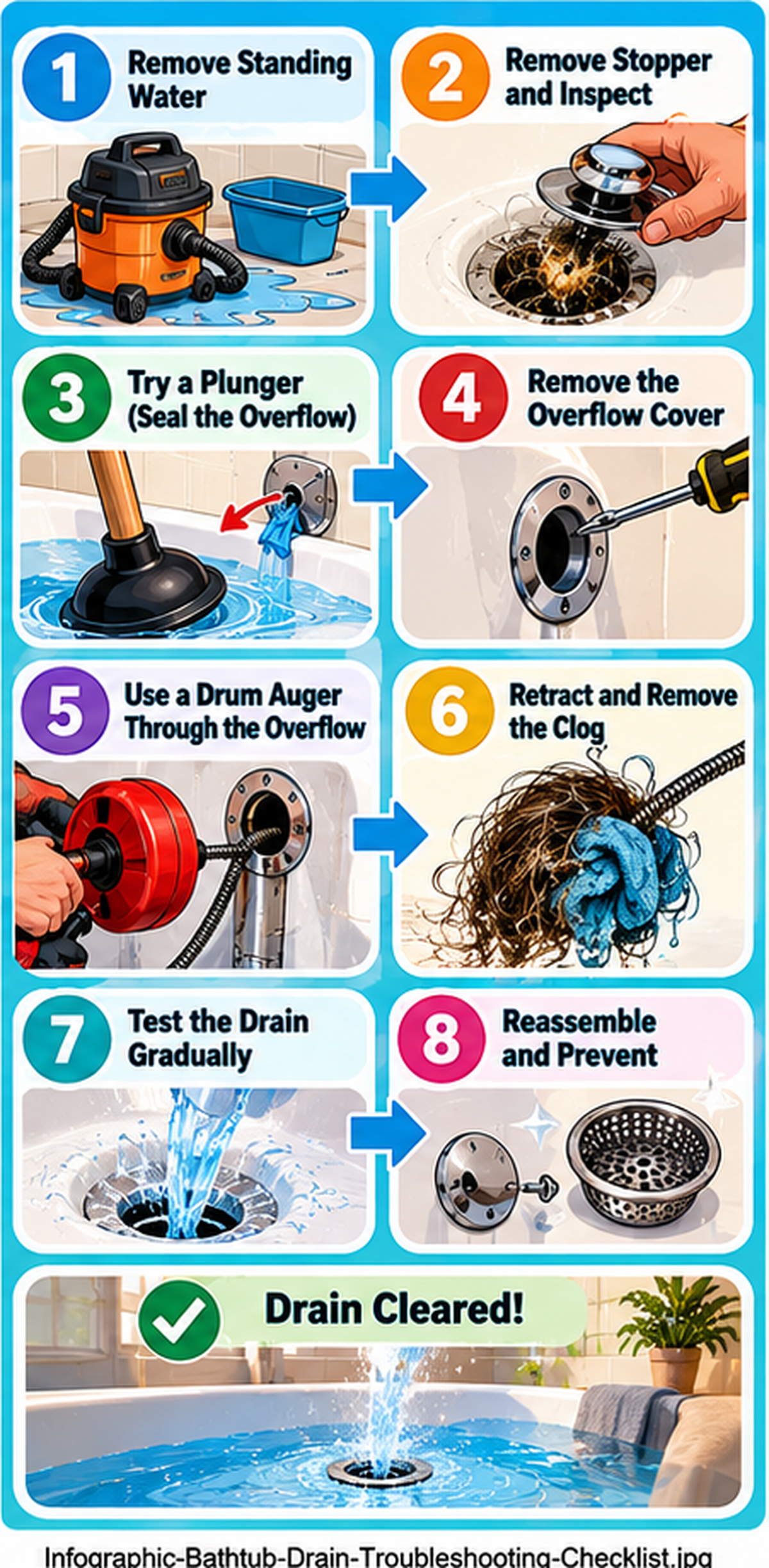
- Remove most standing water and inspect the drain opening with a flashlight.
- Remove the stopper if it is easily removable.
- Use the existing claw or hair tool only for material within easy reach.
- Avoid pouring chemical drain cleaner into the system.
- Remove the overflow faceplate carefully.
- Remove trip-lever linkage if the tub has it and it interferes with access.
- Feed a 1/4-inch × 25-foot drum auger through the overflow opening.
- Rotate clockwise with gentle pressure until the cable negotiates the trap.
- When suspicious soft resistance is found, stop trying to punch through and begin trying to snag the material.
- Retract slowly while continuing gentle rotation.
- Inspect the cable for hair, fibres or debris and repeat if necessary.
- Test the drain with a small amount of water.
- Check for an access panel if the object cannot be retrieved.
- Stop before cutting concealed plumbing unless you are comfortable rebuilding and leak-testing it.
That sequence gives you several inexpensive opportunities to solve the problem before the plumber becomes necessary. More importantly, every step teaches you something about the blockage instead of relying on guesswork. Even if the auger does not immediately fix the drain, you may learn whether the obstruction is reachable, whether the cable is bringing back hair or fabric and whether the line is open farther downstream.
Good DIY troubleshooting is not random experimentation. Each attempt should narrow the possibilities and guide the next step.
When It Is Finally Time to Call a Plumber
There is nothing heroic about turning a $400 drain-cleaning problem into a $4,000 water-damage problem. There is a point where stopping becomes the smart DIY decision, and recognizing that point is part of doing the job properly. Call a professional if several drains or toilets are backing up simultaneously, sewage is entering the bathtub, water is leaking below the tub, old plumbing begins moving or cracking while you work, the auger repeatedly jams in an inaccessible fitting, or removing the obstruction clearly requires cutting concealed plumbing that you are not equipped to rebuild.
I would also consider professional help if a proper 25-foot auger repeatedly travels through the line without improving drainage and you cannot confidently determine where the blockage is. At that point, a plumber may use a more powerful cable machine, different retrieval heads or a drain camera to determine exactly what is happening. The goal was never to avoid a plumber under all circumstances; the goal was to avoid paying a plumber for something you could reasonably solve yourself.
There is a big difference between those two ideas.
How to Prevent Another Bathtub Drain Disaster
Once you finally get the tub draining again, prevention is ridiculously cheap compared with doing this twice. Install a drain screen or hair catcher that prevents both hair and larger objects from entering the opening. Clean it regularly instead of allowing debris to build up underneath it.
Keep loose shower cloths, washcloths and scrubbers away from an uncovered drain, especially if they are small enough to fold and disappear through the opening. Pay attention when the bathtub starts draining more slowly than normal because a slow drain is usually the warning stage. Waiting until the tub no longer drains at all simply gives the debris more time to become compacted.
A five-minute cleaning every few weeks becomes much more appealing after you have spent an evening feeding steel cable through an overflow pipe.
Final Verdict: The $5 Tool Failing Does Not Mean You Need a $500 Plumber
This is probably the most important lesson from the entire job. If a cheap three-foot drain grabber goes into your bathtub only a short distance and stops, that does not necessarily mean you have reached an impossible clog. You may simply be using the wrong entrance and the wrong tool.
Bathtub plumbing changes direction underneath the tub, and a short retrieval claw may not be capable of following that path. The overflow opening gives you a much better route, while a flexible 1/4-inch drum auger gives you the ability to negotiate bends and reach the trap. For ordinary hair and soap buildup, clean the drain opening, plunge correctly and then snake through the overflow if necessary.
For a suspected washcloth or foreign object, change your mindset. Do not pour chemicals onto it, do not blindly hammer it farther down the plumbing and do not assume every bit of resistance means you have reached the obstruction. Remove the overflow cover, feed the auger slowly, feel what the cable is doing and use controlled rotation to snag the obstruction and bring it back toward you.
If that works, you may solve an expensive-looking problem with a reusable plumbing tool and an hour of patient troubleshooting. If it does not work, the effort still has value because you now know considerably more about where the blockage is, what the cable encountered and whether the problem truly requires professional equipment. That is the difference between blindly calling a plumber because the bathtub is clogged and calling one because you have already eliminated the realistic DIY solutions.
Sometimes the plumber is still the right answer. But a stubborn bathtub drain deserves a proper DIY attempt first.



I have this exact same problem. I’m hoping this auger can do the job. I never even considered sealing the overflow drain when plunging and using it for the auger. Good stuff, wish me luck. I’ll probably return the auger to home Depot after to save some money lol