
Pallet Wood Projects That Actually Sell—and Why Most DIY Sellers Fail
Almost everyone who starts building with pallets eventually has the same thought: Could I make some money doing this?
It usually begins with one simple project. You build a planter for your backyard, put together a rough bench, or make a small shelf from leftover boards. Someone sees it and says, “You could sell those.” Suddenly, the pile of old pallets beside the garage does not look quite as useless as it did before.
That is part of what makes pallet woodworking so appealing. The wood is often free or inexpensive, the projects can be built with ordinary tools, and the finished product can still feel solid, useful, and unique. In a world full of plastic furniture and particleboard products that may not survive more than a few seasons, a sturdy handmade item has real appeal.
Working with reclaimed wood also changes the way you look at materials. At first, you see an old pallet, a few short boards, or construction scraps that need to be hauled away. After you have completed a few projects, you start seeing planters, shelves, trellises, benches, firewood racks, storage boxes, privacy screens, and workbenches hiding inside the pile.
However, there is an important reality that many pallet-project videos and “100 amazing pallet ideas” articles do not explain: most pallet projects are not especially easy to sell.
Making something does not automatically mean someone wants to buy it. Many online pallet ideas are decorative novelties, awkward pieces of furniture, or complicated projects that take far longer to build than anyone will pay for. The projects with the best chance of selling are usually the practical ones. They solve a problem, organize a space, support a garden, provide storage, or make a backyard more comfortable.
Useful projects usually beat clever ones.
Why Some Pallet Projects Sell and Others Do Not
One of the easiest mistakes to make is building whatever looks interesting without first asking whether anyone actually needs it. A project may be fun to build and still be difficult to sell.
Most buyers are not searching for the most complicated piece of pallet art imaginable. They are generally looking for something useful, attractive, affordable, and different from the mass-produced version they could buy at a large store. A strong planter, simple garden bench, sturdy firewood rack, or well-built privacy screen is easy to understand. The buyer can immediately picture where it would go and how it would improve the property.
Complexity does not necessarily increase value. A decorative project with dozens of cuts and intricate details may take two days to build, while a simple planter may take only a few hours. If buyers are willing to pay roughly the same amount for both, the simpler product is clearly the better business choice.
Size matters as well. Tiny projects compete with inexpensive products available online and in discount stores. At the other extreme, very large projects can be hard to store, move, deliver, and sell. For local sales, the ideal project is often large enough to feel substantial but still small enough to fit inside an SUV, van, trailer, or pickup truck.
The best pallet products tend to sit in that middle ground: useful, visually appealing, repeatable, and manageable to transport.
Why Reclaimed Wood Appeals to Buyers
A lot of modern furniture looks good in a photograph but feels lightweight and temporary once it is assembled. Thin veneers, particleboard, plastic fittings, and weak fasteners can make even an expensive product feel disposable. Reclaimed-wood projects often have the opposite effect. They look heavier, feel more permanent, and carry signs that an actual person built them.
That handmade appearance fits naturally with the growing interest in gardening, homesteading, self-sufficiency, cabins, cottage-style decorating, backyard living, and locally produced goods. Planters, trellises, potting benches, firewood racks, shelves, privacy screens, and outdoor seating all fit comfortably into that world.
Reclaimed wood also has character that new material sometimes lacks. Knots, colour variation, old saw marks, nail holes, and weathering can make a project more interesting. Small imperfections that would look unacceptable on a polished dining-room table may feel completely appropriate on a garden planter or rustic outdoor bench.
That does not excuse poor workmanship. A rustic product should still be solid, safe, and intentionally built. It should not wobble, rack from side to side, contain exposed nails, or leave splinters in someone’s hands. Rustic should mean character—not careless construction.
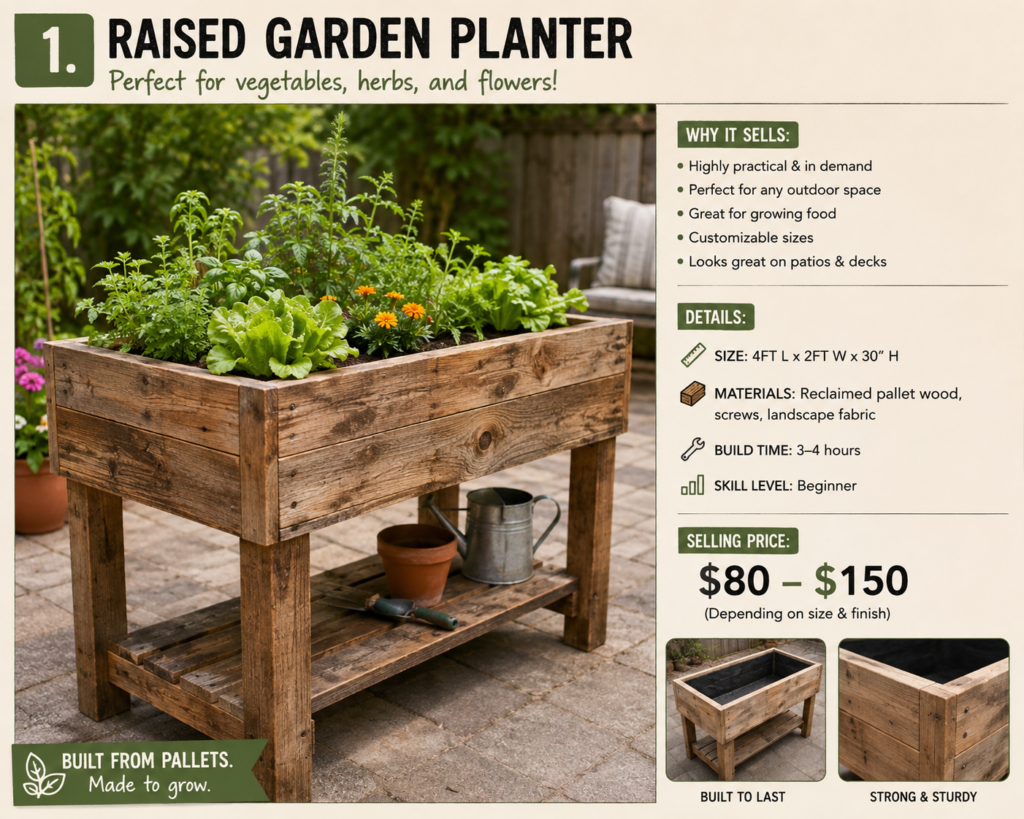
Raised planters are one of the strongest pallet projects for a beginner because they are useful, attractive, and relatively straightforward to build. Gardening appeals to homeowners, renters, families, older adults, and people trying to grow more of their own food. A raised planter can also make gardening more comfortable by reducing the amount of bending required.
Planters are easy to customize. You can build a simple ground-level box, raise it on legs, add a lower storage shelf, attach a trellis, install wheels, or offer several standard sizes. They also photograph extremely well once they are filled with herbs, flowers, lettuce, or vegetables.
The main issue is strength. Wet soil is surprisingly heavy, and long unsupported walls can bow outward once the planter is filled. Strong corner posts, midpoint supports, proper fastener spacing, and occasional cross-bracing can prevent that problem.
Drainage is equally important. A planter that traps water will damage plant roots and encourage the wood to rot. Drainage holes and a suitable landscape-fabric liner can help hold the soil in place while allowing excess water to escape. Materials and finishes should be chosen carefully when the planter will be used to grow food.
Finishing makes a major difference. A rough box made from grey pallet boards may still look like a discarded shipping pallet. Sand the areas people will touch, soften the sharp corners, straighten the visible edges, and apply an appropriate exterior finish, and the project begins looking like a deliberate garden product.
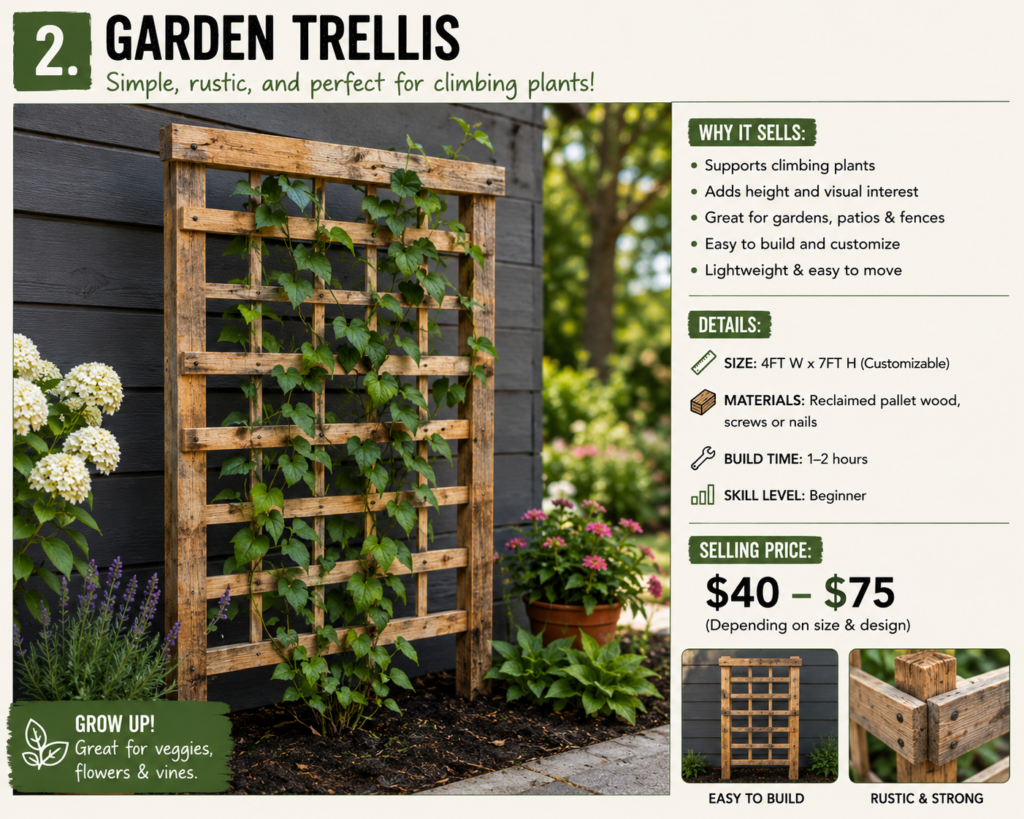
Trellises are a good way to use narrower pallet boards and smaller scraps that may not be suitable for furniture. They are light enough to move easily, simple enough to build in batches, and useful for beans, peas, cucumbers, climbing flowers, decorative vines, and some tomato-growing setups.
There are many ways to build them. A flat trellis can sit against a wall or fence. A freestanding trellis can divide part of a garden. An A-frame design works well over a vegetable bed, while a planter with an attached trellis combines two products into one.
Trellises also offer good opportunities for sets and add-ons. A buyer may want two matching panels, a trellis on each side of a walkway, or a planter with a coordinating climbing structure.
The design does not need to be complicated, but it should be straight, reasonably lightweight, and strong enough to support mature plants. Keep in mind that a trellis covered with thick vines can catch a surprising amount of wind.
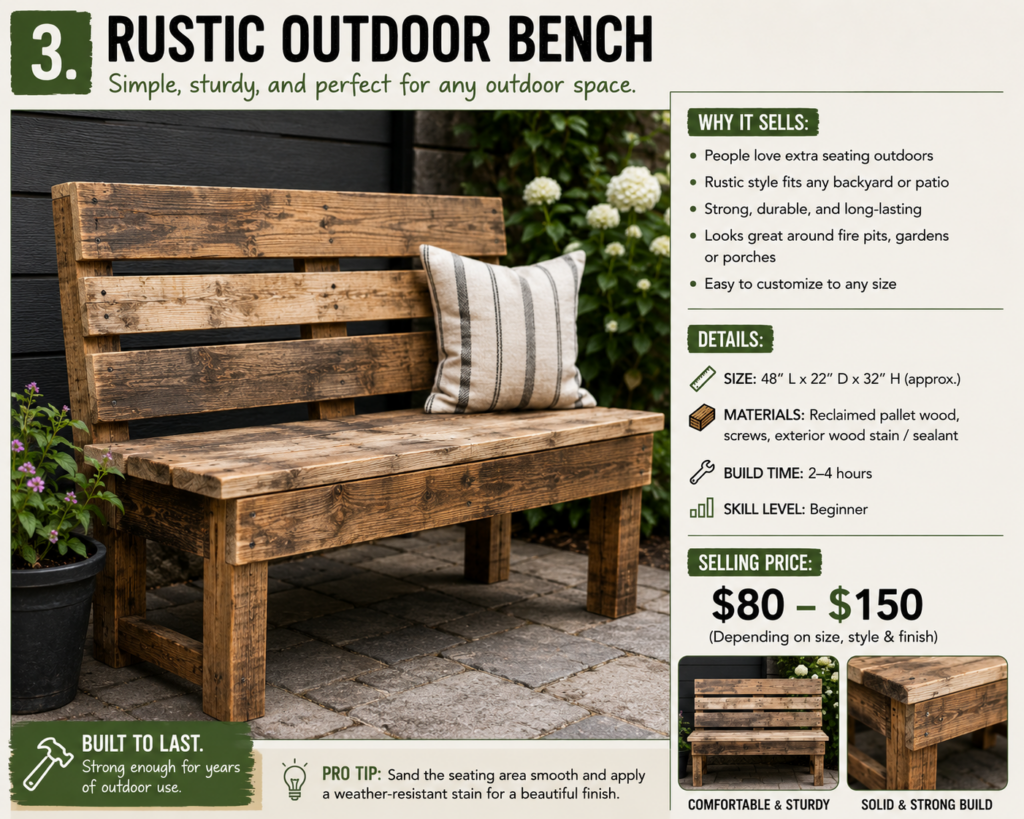
A simple outdoor bench can feel like a substantial product without requiring fine-furniture joinery. Thick boards, visible grain, strong legs, and a natural or dark exterior finish can create exactly the kind of rustic appearance many homeowners want around a firepit, porch, garden, cabin, or backyard path.
The most important part of a bench is not decoration. It is stability. The legs should not spread, the frame should not rack from side to side, and the seat should not flex excessively when someone sits down. Strong joints, diagonal support where needed, and properly placed fasteners are much more important than adding unnecessary decorative pieces.
Comfort matters too. Even a basic bench should have a reasonable seat depth and height. Any boards that contact clothing or skin need more sanding than the hidden parts of the frame.
It is also worth thinking about weight. A heavy bench may feel durable, but buyers still need to move it through gates, across lawns, or onto decks. Solid is good; needlessly massive is not.
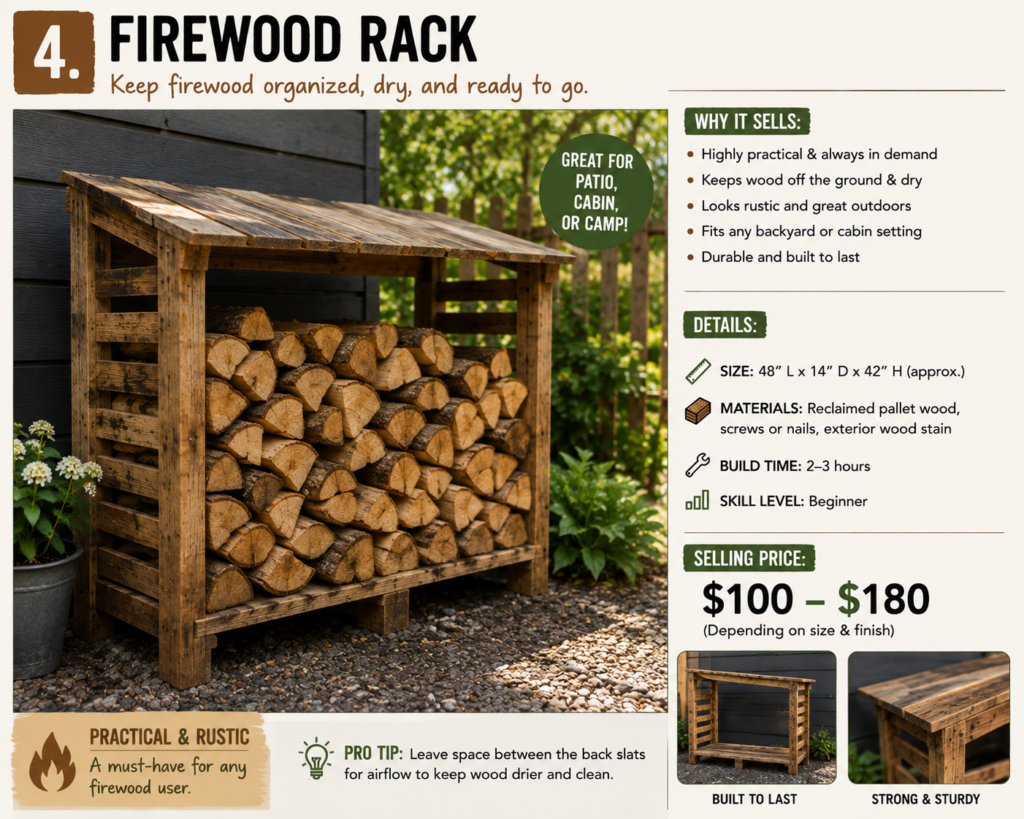
Firewood racks are practical products for anyone with a fireplace, woodstove, outdoor firepit, cabin, sauna, or camping property. They keep split wood organized and, more importantly, raised off wet ground.
A basic rack can be little more than a reinforced base with upright ends. More developed versions can include a roof, a separate kindling shelf, wheels, or divided storage. Small porch racks can be sold to homeowners who only need enough wood for occasional fires, while larger covered racks may suit rural properties and cabins.
Firewood is heavy, so a rack should be built for weight rather than appearance alone. The base needs proper support, the ends should resist spreading, and the structure should remain stable as wood is added and removed.
Air circulation matters as well. A tightly enclosed wooden box may trap moisture. A rack with space around the logs will keep the wood drier and make the product more useful.
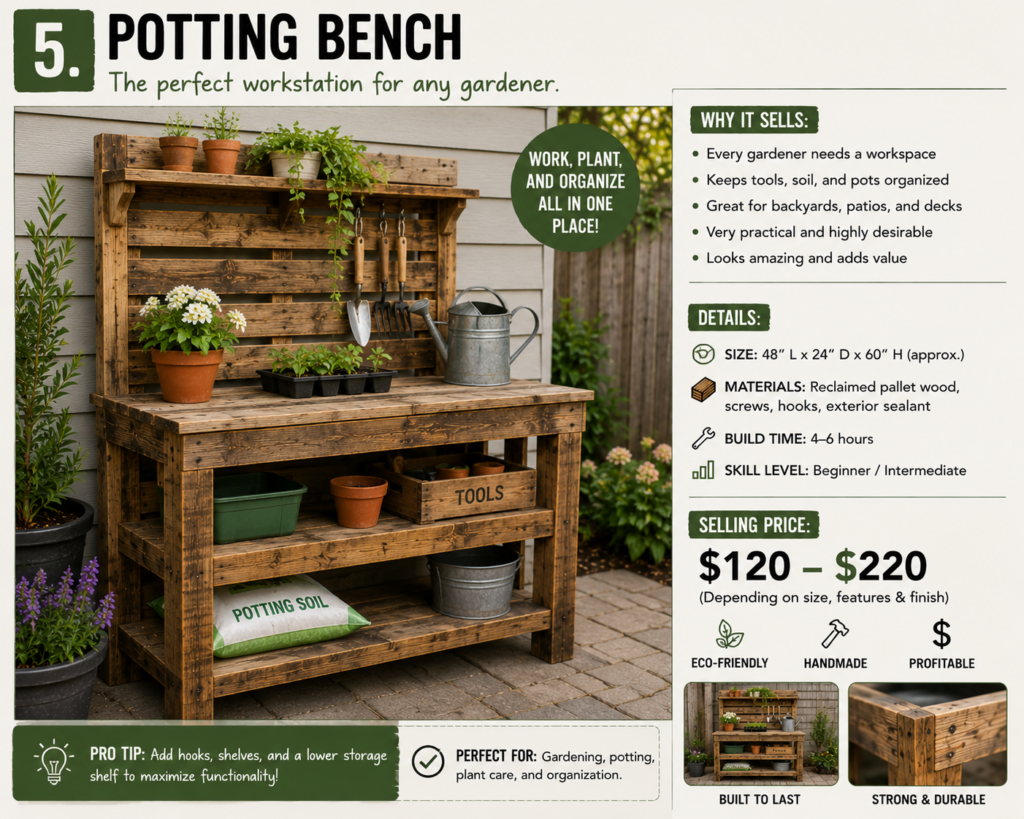
A potting bench combines several useful features into one product. It gives gardeners a comfortable work surface for transplanting seedlings, preparing pots, mixing soil, and organizing tools. It can also include shelves, hooks, bins, and storage underneath.
Because the purpose is obvious, a potting bench can have strong visual appeal in a listing. Stage it with pots, a watering can, a bag of soil, and a few hand tools, and buyers immediately understand how it would fit into their gardening routine.
A basic version can be built like a small workbench with a raised backboard. From there, you can add a lower shelf, tool hooks, side shelves, a removable soil bin, wheels, or a moisture-resistant work surface.
Potting benches take more material and time than a simple planter, but they can also justify a higher price. They are especially suitable for sellers who want to build a recognizable group of garden-related products rather than random one-off items.
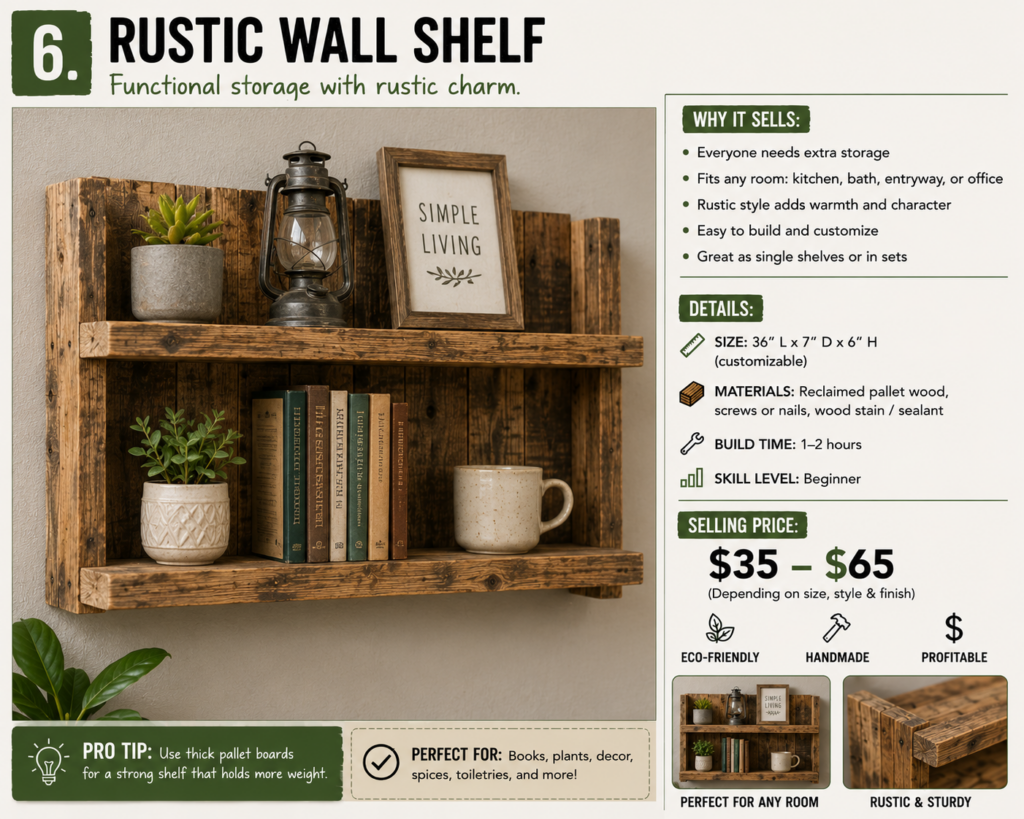
Shelving is one of the most versatile uses for reclaimed wood because nearly everyone needs more storage. Pallet boards can become garage shelves, workshop organizers, bathroom shelves, entryway storage, spice shelves, plant displays, or simple wall-mounted units.
Rustic shelving works best when the design is uncomplicated and the wood itself provides the visual interest. Thick boards, attractive grain, dark stain, and visible reclaimed character can make a plain shelf feel much more substantial than a mass-produced alternative.
Indoor shelves require more careful finishing than outdoor utility projects. The surfaces should be clean, dry, and free of odours, contamination, exposed fasteners, and rough splinters. Shelves also need appropriate brackets or mounting hardware.
A shelf can be structurally strong but still be dangerous if it is attached poorly. Anyone selling wall-mounted shelving should provide clear information about proper installation, especially when the customer plans to place books, dishes, or other heavy items on it.
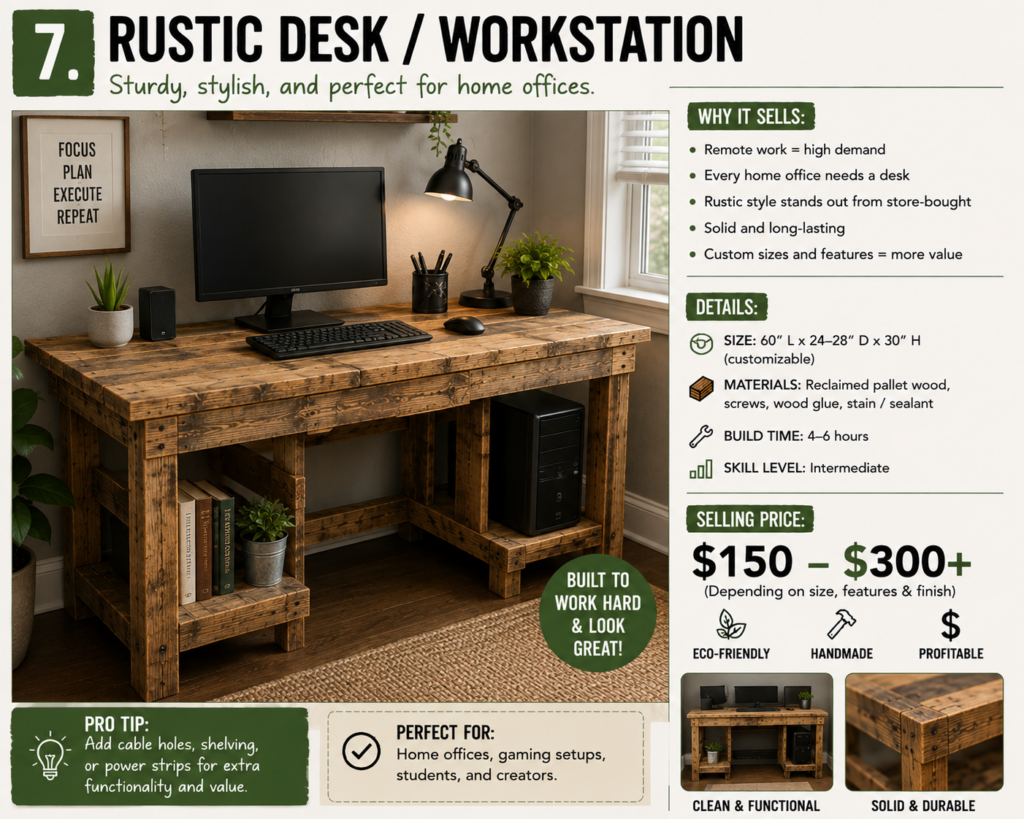
Home offices, gaming setups, content-creation spaces, and remote work have created steady demand for large, sturdy desks. A reclaimed-wood desk can appeal to someone who wants a more distinctive work surface than the lightweight flat-pack options sold in furniture stores.
The simplest design may be a thick wooden top on sturdy legs. Added features such as monitor stands, cable holes, lower shelves, power-bar mounting, printer storage, or a raised back shelf can make the desk feel more complete.
Desks demand better material selection than most outdoor projects. Warped boards, uneven joints, protruding fasteners, and rough surfaces will be much more noticeable when someone is writing or using a computer. The top needs to be flat enough to work on comfortably.
Long spans also require support underneath. Without bracing or a proper frame, a wide desktop can sag over time. This is not the easiest beginner product, but a well-built desk can carry a much higher perceived value than a small pallet craft.
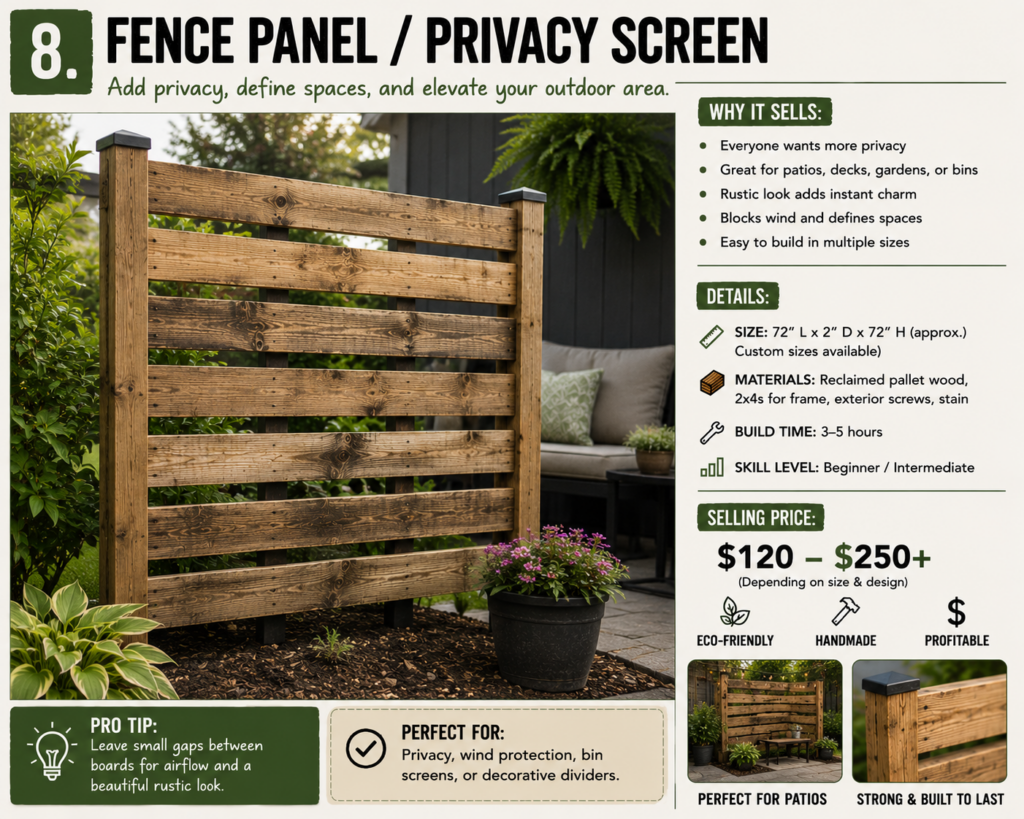
Privacy screens and fencing panels are particularly useful when you have a large pallet stockpile. They consume plenty of material and solve common problems around patios, garbage bins, air-conditioning units, compost areas, and property boundaries.
The rustic appearance of pallet wood works naturally in outdoor settings. Slight variation between boards can add character as long as the overall panel is straight, secure, and well supported.
Wind is the main concern. A solid panel can behave like a sail during a storm. Posts, anchors, braces, and board spacing all need to account for that pressure. Leaving small gaps between boards can reduce wind resistance while still providing privacy.
Fences and larger screens may also be subject to municipal rules concerning height, setbacks, visibility, and property lines. Those requirements need to be checked before installation. A decorative freestanding screen may be treated differently from a permanent fence, but buyers should never assume that no rules apply.
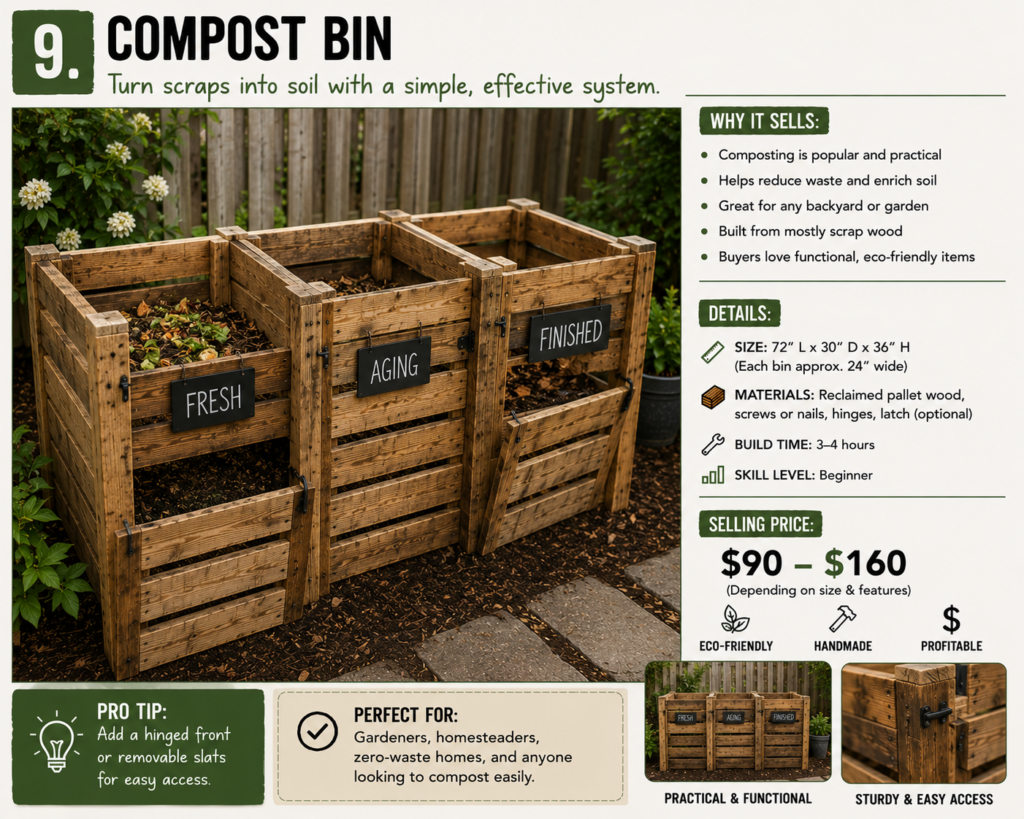
Compost bins are an excellent use for pallet boards that are too rough for indoor furniture but still structurally sound. They do not require a furniture-grade finish, yet they provide an obvious environmental and practical benefit.
A basic three-sided bin is simple to build. More advanced versions can include hinged fronts, removable slats, lids, or multiple compartments for fresh material, aging compost, and finished compost.
Pallet wood can also be used for leaf-storage corrals, recycling-bin screens, garbage-can enclosures, and other outdoor utility structures.
These projects can remain fairly rough, but they still need to be safe. Sharp nails, unstable walls, badly split boards, and weak hinges will make even a utility project feel poorly built.
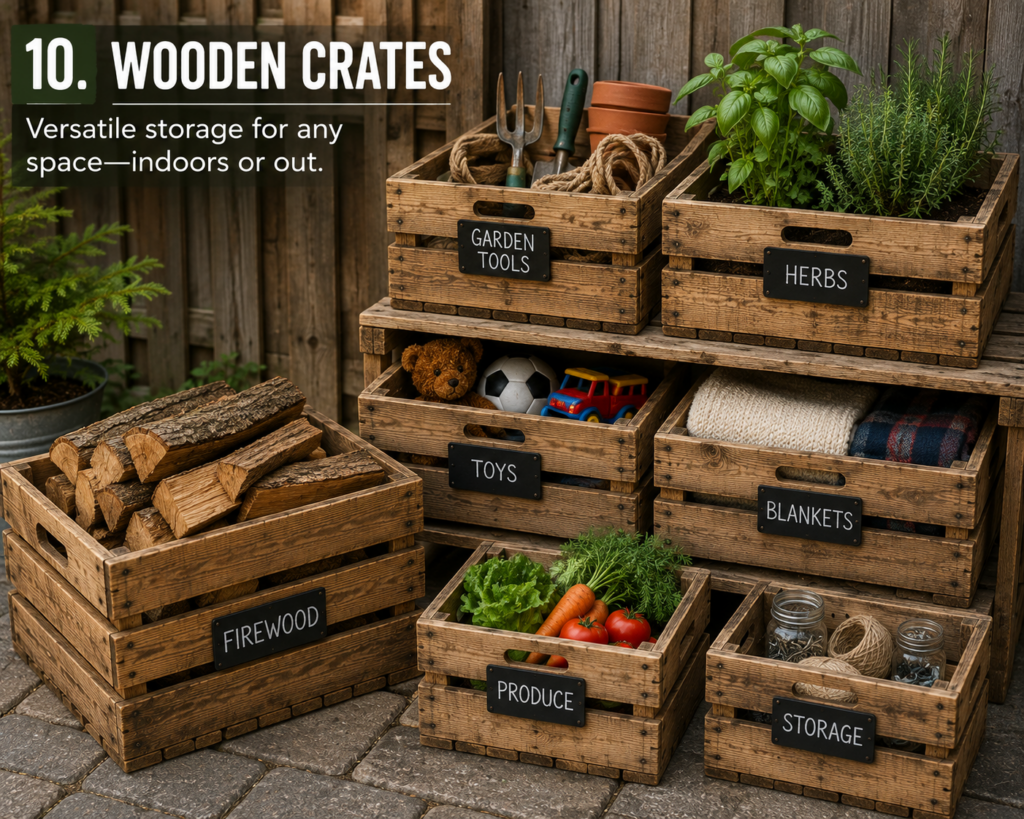
Wooden crates can hold garden tools, toys, firewood, sports equipment, boots, produce, workshop supplies, or outdoor cushions. They are smaller than most furniture projects and easier for buyers to transport.
Crates can be sold individually, in matching sets, or incorporated into larger storage benches and shelving units. Standard sizes make them easier to reproduce, stack, and price.
The challenge is labour. A small crate does not sell for the same amount as a large planter, but it may still require dismantling pallets, cutting numerous pieces, sanding edges, and assembling the product. A simple design and repeatable cutting process are essential if you want crates to be profitable rather than merely useful for consuming scraps.
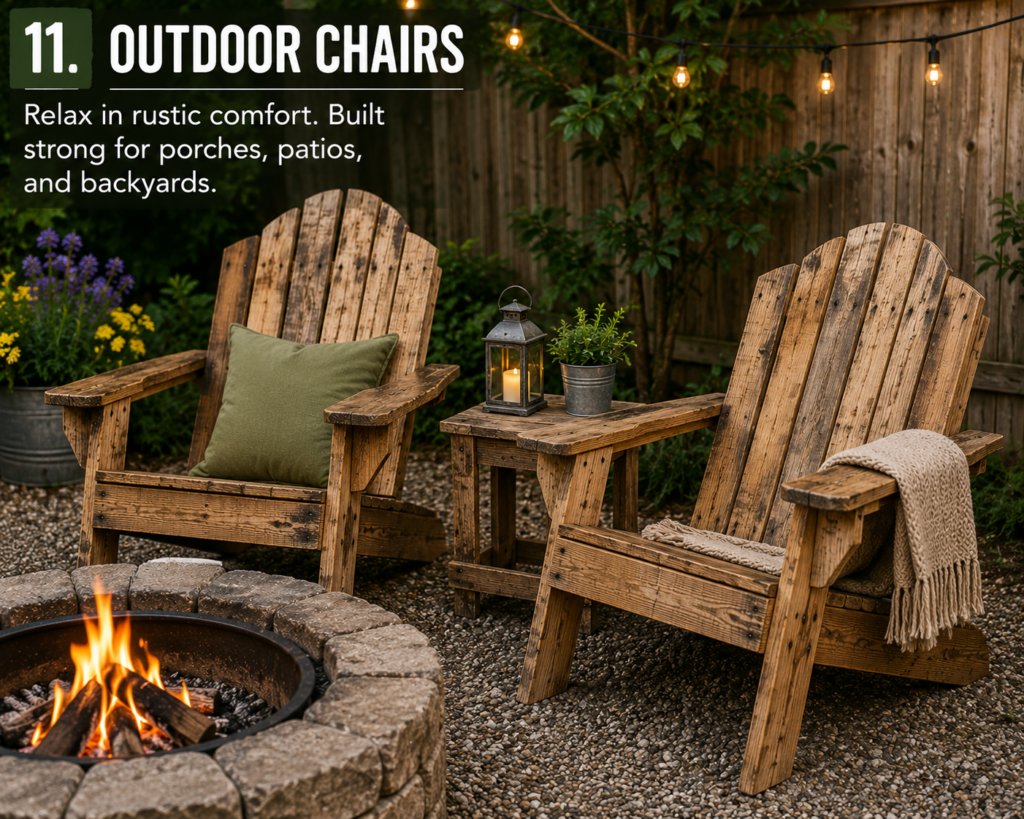
Outdoor chairs have strong sales potential, but they also demand more care than many beginner projects. A chair has to be comfortable, stable, and capable of supporting shifting body weight—not merely look good in a photograph.
Adirondack chairs remain popular, although they involve more angled cuts, shaping, and fitting than a basic square-framed chair. Simpler campfire, porch, and garden-chair designs may be more approachable when starting out.
Once you develop a reliable pattern, chairs become easier to reproduce. Templates can speed up repeated cuts and help every unit come out the same size.
Before selling any chair, test it thoroughly. Sit in it, lean back, move around, and check for flexing, rocking, or loose joints. Furniture failure can injure someone, so the standard needs to be higher than it would be for a decorative sign or flower box.
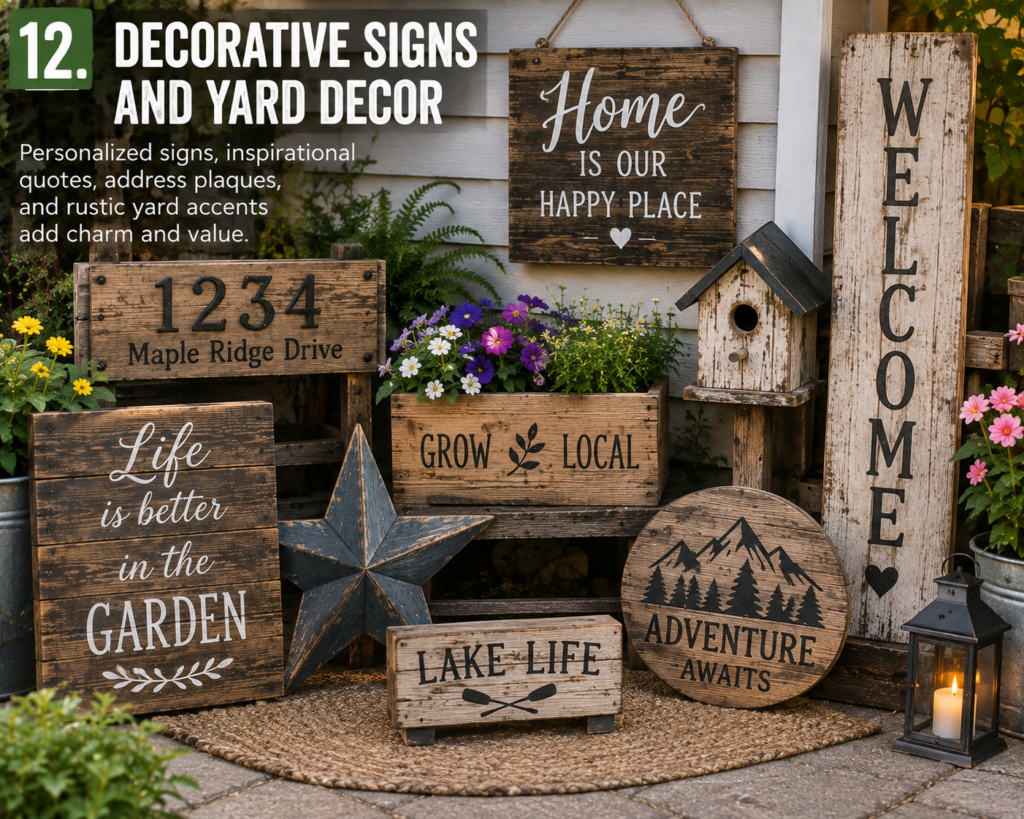
Decorative pallet projects can still sell, especially when they are personalized. Address signs, welcome signs, cabin signs, garden markers, porch decorations, family-name signs, and small business signs can all appeal to buyers who want something unique.
Painting, engraving, stencilling, layering, and wood burning can add value without requiring a large amount of lumber. Smaller signs are also easier to store, transport, and potentially ship.
The difficulty is competition. Generic signs are available almost everywhere, often at very low prices. Personalized names, addresses, local sayings, cottage names, and custom designs are harder for mass-produced products to replace.
Decorative items may work best as add-ons rather than the main focus of a pallet business. Someone buying a planter or bench may also be interested in a matching garden marker or sign.
Why Outdoor Pallet Projects Are Often Easier to Sell
Reclaimed wood tends to look most natural outdoors. Inside a house, buyers may expect precise joints, smooth surfaces, and furniture-grade finishing. In a garden or backyard, grain variation, weathering, and rough character feel more appropriate.
Outdoor products also connect to the way people imagine using their property. A planter is not just a wooden box; it represents herbs growing beside the kitchen, vegetables on the patio, or flowers brightening a bare corner. A bench suggests evenings by the firepit. A trellis suggests a greener, more private garden.
That emotional picture helps sell the product. Buyers need to see how the item fits into their lives.
Selling Pallet Projects Locally
Local selling works differently from selling through an online marketplace.
Small online products need to be lightweight, easy to package, and economical to ship. Local buyers are more open to benches, planters, firewood racks, and potting stations because they can pick them up directly or pay for nearby delivery.
Facebook Marketplace, Kijiji, community groups, garage sales, farmers’ markets, craft fairs, roadside displays, garden centres, and word-of-mouth referrals can all work. Local landscapers and property-maintenance companies may also be interested in products they can offer to their own customers.
Transportation should be considered before you settle on a design. A beautiful product may still be difficult to sell if it does not fit through a gate or inside an ordinary vehicle. Measure the finished item, know roughly what it weighs, and decide whether you are willing to offer delivery.
Delivery should not automatically be free. Fuel, loading, driving, unloading, and vehicle wear all have a cost.
Finishing and Presentation Matter
The difference between an attractive reclaimed-wood product and something that looks like broken pallets nailed together often comes down to finishing.
Remove exposed nails and staples. Cut away badly damaged ends. Replace boards that are deeply split or rotten. Sand the places people will touch, soften sharp corners, align visible edges, and use consistent fasteners.
You do not need to sand away every mark and imperfection. Reclaimed character is part of the appeal. The goal is to make the product safe and intentional without turning it into something that looks factory-made.
An appropriate exterior stain or sealant can also unify boards that began in several different colours. A consistent finish makes the project look like one finished piece instead of an assortment of unrelated scraps.
Photography is part of presentation too. A planter beside a garbage pile in a dark garage will not look nearly as valuable as the same planter staged on a clean patio with flowers or herbs inside it.
Use natural light, remove clutter, and photograph the entire project from several angles. Show important joints, storage areas, details, and scale. If the product has a flaw, show it honestly rather than surprising the buyer at pickup.
Simple Designs Are Often More Profitable
Complicated projects create more opportunities for wasted material, bad cuts, long sanding sessions, assembly errors, and customer complaints. They also take longer to reproduce.
A simple design may appeal to more buyers and produce a better hourly return. Once you find something that sells, build a repeatable process around it. Create a cut list, save templates, use jigs where helpful, and offer two or three standard sizes rather than reinventing every project.
The first planter may take half a day because you are deciding on every measurement as you go. By the fifth planter, you should know exactly what to cut, where to drill, and how to assemble it.
That improvement is where a hobby begins turning into a workable small business.
Choosing Pallets Safely
Not every pallet is suitable for a DIY project. Pallets may have been exposed to oils, chemicals, food spills, mould, pests, or materials you know nothing about.
Inspect every pallet carefully. Avoid anything with strong odours, oil stains, unknown spills, heavy mould, rot, insect damage, badly broken boards, or suspicious paint and coatings.
Pallet stamps can provide some information. Pallets marked HT were heat treated. Pallets marked MB were treated with methyl bromide and should not be used for DIY projects.
A safe-looking stamp does not guarantee that the pallet stayed clean after it was manufactured. Its working history still matters. Be especially cautious when building anything that will touch food, garden soil, children, pets, or indoor living areas.
Wear gloves and eye protection while dismantling pallets. Hidden nails can damage tools or become projectiles, and reclaimed-wood dust may contain dirt, coatings, or contaminants. A respirator or suitable dust mask is also sensible when sanding.
When you cannot establish where a pallet came from or what it carried, walking away from it may be the smartest choice.
Pricing Your Work
Free wood does not mean a project costs nothing.
Fasteners, sandpaper, saw blades, stain, brushes, electricity, tool wear, delivery, failed cuts, and your time all have value. Time spent answering messages and arranging pickups also belongs in the calculation.
A useful starting formula is:
Materials + consumables + labour + overhead + profit
Track the real build time rather than estimating from memory. A planter sold for $100 may sound profitable until you realize it took eight hours, used $25 in supplies, required an hour of messaging, and included free delivery across town.
Underpricing can also make a product seem suspiciously cheap. Buyers may assume the item is unstable, unsafe, or poorly constructed.
You do not need to charge professional furniture prices while you are still learning, but you should avoid treating your labour as worthless simply because the pallet was free.
Custom Orders Versus Standard Products
Custom work can bring in more money, but it also creates more opportunities for confusion. Customers may request unusual dimensions, different colours, added shelves, engraving, delivery, or last-minute design changes.
Before beginning custom work, confirm the dimensions, finish, features, total price, deposit, delivery arrangement, and expected completion date. Put those details in writing, even if it is only through a clear message exchange.
A deposit is reasonable when the project is highly specific. It protects you from spending hours building something that will be difficult to sell to anyone else if the customer disappears.
Standard products are easier to price and produce. Offering a few sizes, finishes, and optional extras gives customers some choice without turning every order into a completely new engineering project.
Mistakes That Cost Beginner Sellers Money
The biggest mistakes are rarely dramatic. They are usually small decisions that slowly destroy the profit in a project.
Building something before checking whether people want it is one. Underpricing labour is another. Poor photographs, heavy designs, unsafe pallets, inconsistent dimensions, weak furniture, and free delivery can all turn a promising product into a frustrating experience.
Trying to make too many unrelated products can also make selling more difficult. A clear group of rustic garden products—such as planters, trellises, potting benches, firewood racks, and garden signs—looks more intentional than a random collection of shelves, animal decorations, chairs, and novelty crafts.
You do not have to build everything that can be made from a pallet. Choose a category, develop a recognizable style, and get good at a few repeatable projects.
The Learning Curve Is Normal
The first few pallet projects will probably take longer than expected. Boards will split, measurements will drift, screws will crack the ends of slats, stain will absorb unevenly, and hidden nails may ruin a blade.
That does not mean you are bad at woodworking. It means you are learning how the material behaves.
Every project improves your measuring, cutting, fastening, reinforcement, sanding, finishing, tool control, assembly sequence, and judgement. After enough repetition, you begin spotting weak boards before they split and recognizing where a frame will need extra support.
The first planter may be a slow experiment. The fifth should be noticeably straighter, cleaner, stronger, and faster to build.
That accumulated experience is more valuable than any single project.
What to Build When You Have Too Many Pallets
When a large pile of pallets is taking over part of the yard, the natural impulse is to start building anything that will use them up. That can create a second problem: instead of one organized pallet pile, you end up with several half-finished projects scattered around the property.
Sort the material first. Separate long straight boards, short usable pieces, thick structural blocks, attractive weathered boards, badly damaged wood, and unsafe material that needs to be discarded.
Then choose one or two projects to test. A standard planter, trellis, firewood rack, fence panel, or small shelf is a reasonable place to begin.
Build one prototype and pay attention to how much material it consumes, how long it takes, what goes wrong, and whether the finished project is practical to move. Improve the second version before building several more.
That way, you are not merely getting rid of pallets. You are developing a product.
Final Thoughts
Pallet woodworking is accessible because the starting material can be inexpensive, but free wood by itself does not create a valuable product.
The projects most likely to sell are useful, strong, attractive, and easy for buyers to picture on their own property. Planters, trellises, benches, firewood racks, potting stations, shelves, privacy screens, compost bins, storage crates, and other practical outdoor builds generally have more potential than novelty crafts.
Good presentation matters. Safe material matters. Pricing matters. A repeatable process matters.
Most importantly, you do not need to be a master furniture maker before you build something people value. Start with a practical design, build it safely, improve it with every attempt, and pay attention to what buyers actually respond to.
After a while, that pile of old pallets stops looking like a disposal problem. It begins looking like building material, practice, inventory, and perhaps even a small source of income.
Useful pallet projects usually outperform clever ones.
Some good pointers here: take the time to make your products useful but visually appealing: sand, stain and paint. Also reinforce your creations-> they should be able to take a beating and still be sturdy.