
Best Roofing Materials for Homes, Sheds & Cabins
Choosing a roof is not simply a matter of picking the material that looks best in a photo. The right system has to match the roof slope, climate, building structure, budget, maintenance tolerance, and consequences of a leak. A basic backyard shed may justify a simple, economical covering, while a house, cabin, workshop, or garage may deserve a system that costs more up front but reduces replacement and repair work over decades.
The biggest mistake is treating all roof products as interchangeable. Asphalt shingles, exposed-fastener steel, standing-seam metal, low-slope membranes, cedar, synthetic products, tile, and slate all manage water differently. The goal is to choose a roof that drains correctly, survives local weather, fits the building, and makes financial sense for its expected life.
Roofing Materials at a Glance
For most normal-pitch residential roofs, architectural asphalt shingles remain the practical value choice. Metal becomes compelling when you want a longer service life, low maintenance, snow shedding, or a modern or agricultural look. Membrane roofing belongs on low-slope roofs where shingles are the wrong tool, while cedar, slate, tile, and synthetic products are premium choices driven more by architecture and longevity than lowest initial cost.
A roof’s pitch is written as rise over run: a 4:12 roof rises four inches for every 12 horizontal inches. Asphalt shingles should never be used below 2:12; even from 2:12 to under 4:12, manufacturers require special low-slope underlayment. A steep roof does not automatically rule out shingles—the concern is safe installation and extra labour.
First, Think in Roofing Systems—Not Just Materials
The visible roof covering is only the outer layer of a weather-management system. Under it may be roof sheathing, a self-adhered ice-and-water membrane at vulnerable locations, synthetic or felt underlayment, drip edge, flashing, vents, pipe boots, fasteners, and ridge or wall transitions. A premium roof material can still leak if the flashing at a chimney, dormer, skylight, valley, eave, or sidewall is poorly detailed. Conversely, an economical roofing product can serve well when the assembly is built carefully and maintained.
In Canadian conditions, snow, freeze-thaw cycles, wind, ice dams, and sudden heavy rain punish weak details before they punish the field of the roof. Identify the actual shape first: simple gable, hip, gambrel, shed roof, low-slope addition, or a roof cluttered with valleys and penetrations. The more cuts and transitions it has, the more workmanship and labour cost matter.
Before choosing a covering, answer five questions: What is the pitch? How long should the roof last? Is the building heated? What snow, wind, trees, and rainfall does the site see? And can the structure support the material plus local snow loads?
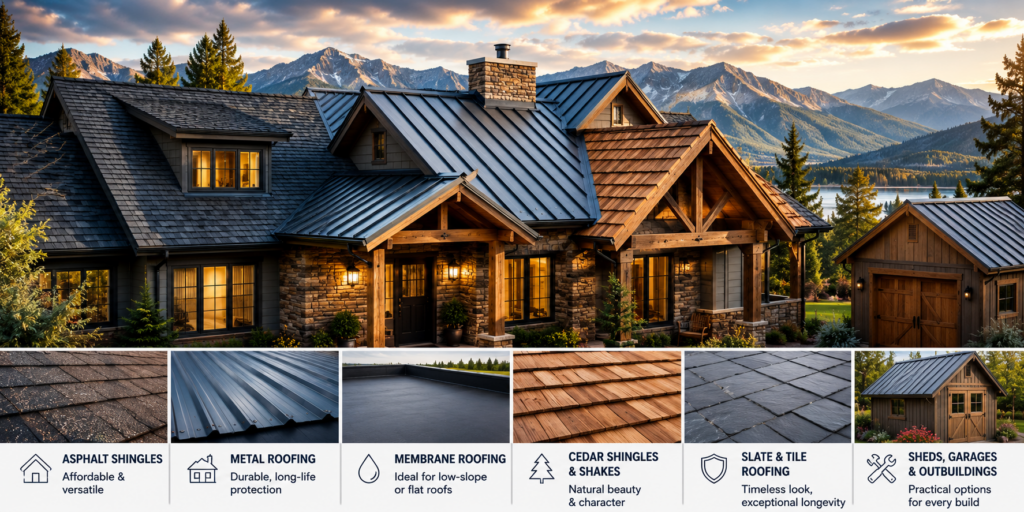
2026 Canadian Cost Snapshot
The following are broad installed-price planning ranges in Canadian dollars per square foot, not quotations. Complexity, height, tear-off, sheathing repairs, insulation, access, roof pitch, and local labour can move a real quote substantially; small sheds can cost more per square foot because minimum labour and delivery still apply.
| Roofing material | Typical installed planning range | Usual reason to choose it |
|---|---|---|
| Architectural asphalt shingles | CAD $6–$13/sq. ft. | Best all-around value for standard slopes |
| Exposed-fastener steel panels | Roughly CAD $8–$14/sq. ft. | Utility buildings, cabins, simple gables |
| Standing-seam metal | Roughly CAD $11–$22/sq. ft. | Long-term, premium residential metal roof |
| EPDM or TPO membrane | CAD $11–$18/sq. ft. | Low-slope roofs and modern flat-roof forms |
| Two-ply SBS / modified bitumen | CAD $15–$25/sq. ft. | Durable low-slope assemblies |
| Cedar shingles or shakes | Roughly CAD $11–$18+/sq. ft. | Traditional appearance and premium character |
| Synthetic slate or shake | Roughly CAD $15–$25+/sq. ft. | Slate or cedar appearance with less weight |
| Clay, concrete tile, or natural slate | CAD $15–$40+/sq. ft. | Long-life architectural or heritage projects |
Published Canadian market guides put asphalt roofing near the lower end of the residential spectrum, while standing-seam metal and low-slope membrane systems cost more; they also show wide variations by region and roof complexity. Treat the numbers above as a budgeting filter, then get at least three local written estimates built around the same scope of work.
Asphalt Shingles: The Standard Value Option
Asphalt shingles remain the default choice on many Canadian homes for a reason: they offer a strong balance of cost, appearance, availability, and repairability. Modern laminated or architectural shingles are thicker and more dimensional than basic three-tab shingles, and they give a house a more substantial look without moving into premium-material pricing. For a straightforward gable roof with adequate slope, asphalt is often the sensible answer—not glamorous, but efficient and proven.
The strengths are practical. Most roofing crews work with shingles, replacement material is easy to find, colour choices are broad, and isolated storm damage can often be repaired without rebuilding the entire roof. Shingles also suit hips, dormers, valleys, and other complicated geometry because small units can be cut and woven into transitions more easily than long panels.
The trade-off is lifespan and slope limitation. A typical asphalt roof should be viewed as a medium-term system, not a forever roof: current Canadian cost guides commonly place installed life in the roughly 15–25-year range, though actual performance depends heavily on product grade, ventilation, sun exposure, wind, and workmanship. Asphalt shingles must not go below 2:12, and shallow roofs between 2:12 and under 4:12 need manufacturer-approved low-slope detailing rather than a standard shingle installation.
Choose asphalt shingles if: you have a conventional sloped house, garage, cottage, shed, or cabin; you want the most cost-effective mainstream option; you may need easy future repairs; and you do not mind replacing the roof sooner than a quality metal system. Avoid treating low-slope shingle work as a shortcut. That is where leaks and premature failures begin.
Metal Roofing: Separate Corrugated Steel From Standing Seam
“Metal roofing” is too broad to be useful on its own. A through-fastened corrugated or ribbed steel panel is not the same system as a standing-seam roof with concealed clips and interlocking seams. Both can be excellent products, but they suit different budgets, details, and expectations. The distinction is particularly important for a house where appearance, long-term weather resistance, and future maintenance matter more than they might on a small storage shed.
Exposed-fastener metal panels are the familiar agricultural-style panels seen on barns, sheds, workshops, and many cabins. Screws pass through the face of the panel and use sealing washers to resist water. The system is fast, relatively economical, lightweight, and very effective on simple roof shapes. It is a smart option for a detached garage, lean-to, workshop, or straightforward cabin roof where the panel runs can be long and clean.
Its limitations should be understood before buying. Exposed fasteners create many penetrations, so screw placement, washer condition, overlap, flashing, and periodic inspection matter. Long panels become more demanding around valleys, skylights, chimneys, or irregular geometry. Metal also needs deliberate condensation detailing, especially over unheated buildings, and snow shedding must not create a hazard below.
Standing seam is the more refined metal option. The panel seams are raised above the water plane, and the clips or fasteners are concealed as the panels interlock. That reduces exposed penetration points and accommodates thermal movement more elegantly. Some mechanically seamed standing-seam systems are designed for low slopes, while certain snap-lock profiles require steeper conditions; the product’s own engineering and installation instructions—not the word “metal”—should decide whether it belongs on a specific roof.
A well-specified standing-seam steel roof can be a long-term system, often planned around several decades of service. Metal Construction Association material discusses coated steel systems with life expectations in the 40–60-year or 50–60-year range, but that should not be confused with a universal guarantee for every panel profile, coating, environment, or installation. Coastal exposure, cut edges, damaged coatings, poor flashing, incorrect fasteners, and neglected details can shorten real-world service life.
Choose exposed-fastener metal if: you want durable, straightforward coverage for a simple shed, barn, workshop, garage, or cabin roof and accept that screws are a future inspection item.
Choose standing seam if: you are roofing a home or serious cabin for the long haul, value a clean architectural finish, want concealed fasteners, and can justify a higher initial investment.
Membrane Roofing: The Correct Answer for Low Slopes
A low-slope roof is not simply a shallow shingle roof. It is a different drainage problem and should be designed as one. Where water moves slowly, laps and seams must be protected differently, penetrations become more critical, and the roof should include positive drainage rather than relying on luck. Membrane systems are designed for that environment.
EPDM is a synthetic rubber membrane valued for flexibility and cold-climate durability. TPO and PVC are thermoplastic single-ply membranes with heat-welded seams; white versions can reduce solar heat gain. SBS or modified-bitumen roofing uses asphaltic membranes in multi-layer assemblies. Each approach has its own attachment method, seam detailing, insulation strategy, and repair procedure.
For a modern house addition, a low-pitch shed roof, a rooftop deck structure, or a flat-roof garage, membrane roofing can be exactly right. It also gives designers freedom to use rooflines that would be impossible or risky with shingles. The downside is that membrane work is unforgiving at drains, parapets, edge metal, pipe penetrations, and wall transitions. Good low-slope work is specialized work, not just “rolling something out.”
Membrane costs can look high compared with basic shingles, but they should be compared against the correct alternative, not against an unsuitable product. Canadian 2026 planning guides place EPDM and TPO roughly in the CAD $11–$18 per-square-foot band and two-ply modified bitumen higher, although insulation, drain work, and perimeter detailing can shift prices dramatically.
Choose membrane roofing if: the roof is low slope, nearly flat, or part of a modern design where shingle laps would not drain reliably; you need a continuous waterproof field; and you are prepared to use a contractor who knows the specific membrane system.
Cedar Shingles, Cedar Shakes, and Roll Roofing
Cedar is a visual choice first and a functional roof second. Properly installed cedar shingles can give a home, cottage, historic-style cabin, or high-end garden structure a warmth that asphalt and metal cannot copy perfectly. Shingles are sawn for a more uniform appearance, while shakes are split or more heavily textured for a thicker, rougher traditional look. Both demand more attention to roof pitch, installation details, material quality, and maintenance than mainstream asphalt.
Cedar is not a low-slope material. The Cedar Shake & Shingle Bureau recommends a minimum 3:12 slope for Certi-label shingles and 4:12 for shakes. It also demands an honest discussion about fire rating, moss, debris, ventilation, local restrictions, and maintenance.
Roll roofing is a different category. It is a low-cost asphalt-based material sold in wide rolls, typically useful for temporary coverage or simple low-value outbuildings where appearance and long service life are not priorities. It has a place, but it is rarely the best long-term choice for a house, a finished cabin, or a building you care about protecting. Do not confuse basic roll roofing with a professionally designed SBS or modified-bitumen membrane system.
Choose cedar if: appearance, character, and traditional architecture justify extra cost and care, and the roof pitch and fire-rating requirements suit the product.
Choose roll roofing only if: the building is basic, the budget is extremely tight, and you understand that you are choosing a short-term, lower-end solution rather than a premium roofing system.
Synthetic Slate, Tile, and Natural Slate: Premium Options With Structural Consequences
Synthetic slate and shake products imitate the look of slate, cedar, or tile while reducing weight. They can be a strong middle ground for homeowners who want a distinctive roof without committing to natural stone, but quality products and skilled installation can still push the price well above asphalt or exposed-fastener steel.
Clay tile, concrete tile, and natural slate belong in a premium category. They can deliver dramatic appearance and very long service lives, but weight, breakage, flashing, roof geometry, and structural capacity must be resolved before installation. A house framed for asphalt shingles cannot simply be assumed to support a heavy tile or slate roof, particularly in snow country. Tile and slate projects should start with a professional review of structure, local requirements, and the specific product’s assembly details—not with a colour sample.
These materials are usually justified on custom homes, heritage properties, high-end builds, or regional architectural styles where the roof is part of the building’s identity. For an ordinary detached shed, they are almost always overkill. For a high-value home intended to stay in a family for generations, they may be completely rational.
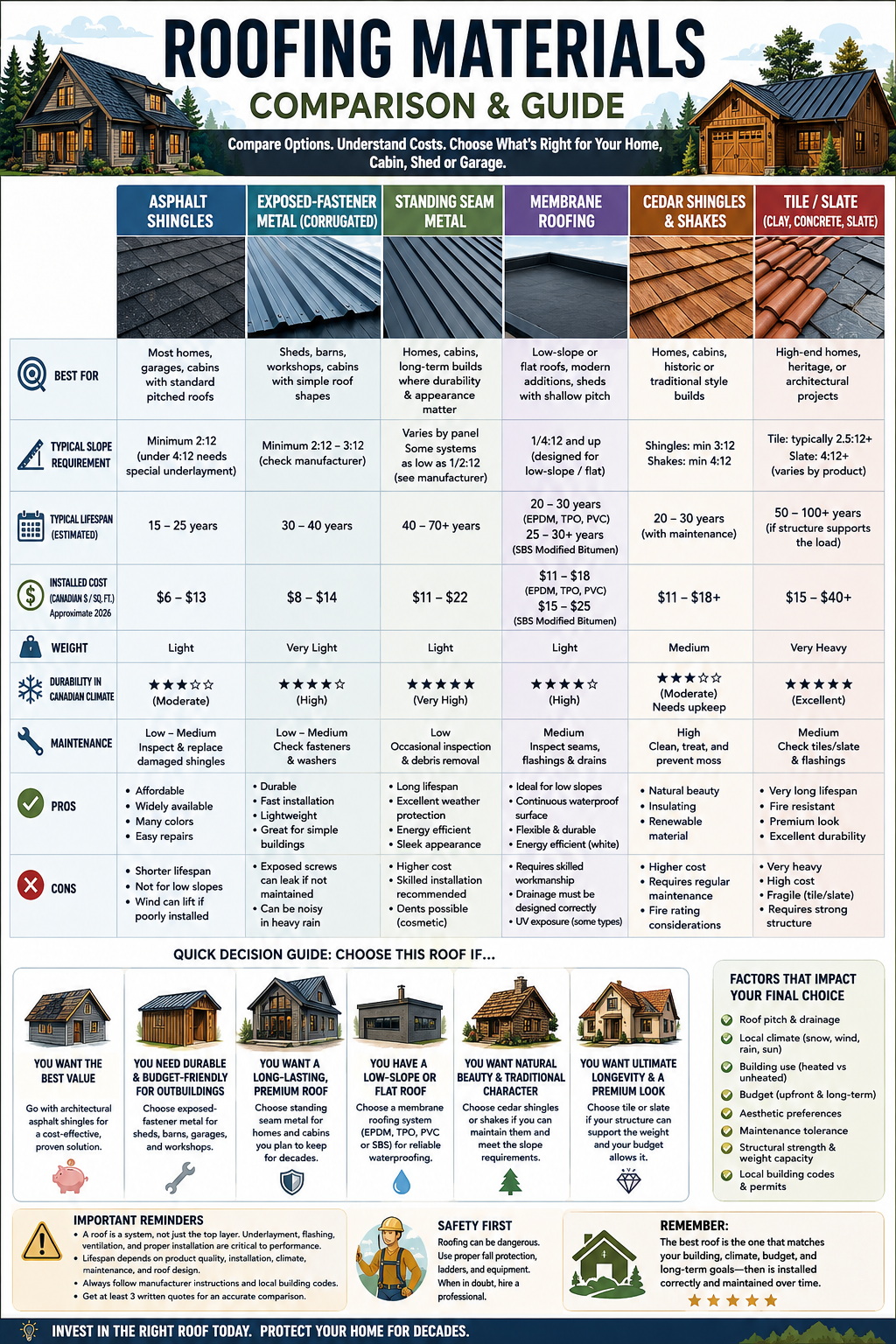
The “Choose This Roof If…” Decision Guide
Use this as a reality check before you start calling suppliers or contractors:
- Choose architectural asphalt shingles if you have a conventional roof pitch, want the best upfront value, need broad colour choice, and want repairs to be simple and affordable.
- Choose exposed-fastener steel if you are roofing a shed, workshop, barn, garage, lean-to, or simple cabin and want durable coverage without the standing-seam price.
- Choose standing-seam metal if you are building or re-roofing a long-term home or cabin, want a refined appearance, and value concealed fasteners and decades of potential service.
- Choose EPDM, TPO, PVC, or SBS membrane if the roof is low slope, nearly flat, or part of a modern design where shingle laps would not drain reliably.
- Choose cedar shingles or shakes if the building calls for a natural, traditional roof and you are willing to manage maintenance, fire-rating considerations, and a steeper roof requirement.
- Choose synthetic slate or shake if you want a premium look with lower structural burden than natural slate or heavy clay tile, while accepting premium pricing.
- Choose clay, concrete tile, or natural slate if your building has been engineered or verified for the load, the architecture calls for it, and long-term appearance matters more than initial cost.
- Choose basic roll roofing only if the building is low-value or temporary and you deliberately accept a shorter-lived result.
Final Advice Before You Commit
The best roof material matches the slope, drainage path, climate, structure, and project budget—not the loudest warranty or the longest internet lifespan claim. For many houses, architectural shingles remain the smart financial choice. For simple detached buildings, exposed-fastener metal is hard to beat. For low slopes, membrane is usually the correct product family. For homes where the roof is meant to be an architectural feature for decades, standing seam, cedar, synthetic slate, tile, or slate may justify the investment.
Roofing is one of the most dangerous DIY categories. Falls, brittle sheathing, steep slopes, heat, sharp metal edges, electrical clearances, and weather changes deserve real respect. Bring in a qualified roofer, engineer, or building official when roof pitch, structural loading, low-slope drainage, snow retention, or permit requirements are uncertain. A roof is cheap only until it leaks.
Related External Links
- IKO: Applying Asphalt Shingles on Low Slopes — Manufacturer guidance on the minimum slope and special underlayment requirements for asphalt shingles.
- Cedar Shake & Shingle Bureau Roof Installation Manual — Technical guidance for cedar shingle and shake roof design, slope, and installation details.
I love the metal roofing particularly the exposed fastener steel due to it’s cost and longevity. I love the sound of falling rain on a metal roof personally and I feel a lot safer in a building with light roofing materials, don’t want to get buried alive you know