
Best Solar Options for Off-Grid Homes and Homesteads
Solar power is one of the most attractive parts of building an off-grid home, cabin, workshop, or homestead. A good solar array can turn an isolated piece of land into a practical place to live, run tools, refrigerate food, pump water, work online, and keep essential systems running without relying entirely on utility lines. But the panels themselves are only the visible part of the system. The real question is not simply, “Which solar panel looks best?” It is, “Which solar setup can reliably match this property, this climate, this roof or land, and this household’s actual power demands?”
That distinction matters because an off-grid solar system has to survive the boring days: several cloudy days in a row, short winter daylight, snow buildup, battery limits, unexpected tool use, guests, water pumping, and a fridge that cannot simply be turned off. A grid-connected system can fall back on the utility when production drops. A true off-grid system must carry its own weight through the entire energy chain, from solar collection to storage to inverter capacity and backup planning. Natural Resources Canada notes that off-grid homes require battery storage, while the U.S. Department of Energy lists batteries, charge controllers, power-conditioning equipment, protection equipment, and monitoring among the typical components of a stand-alone renewable-energy system.
Quick Answer: Which Solar Setup Is Best?
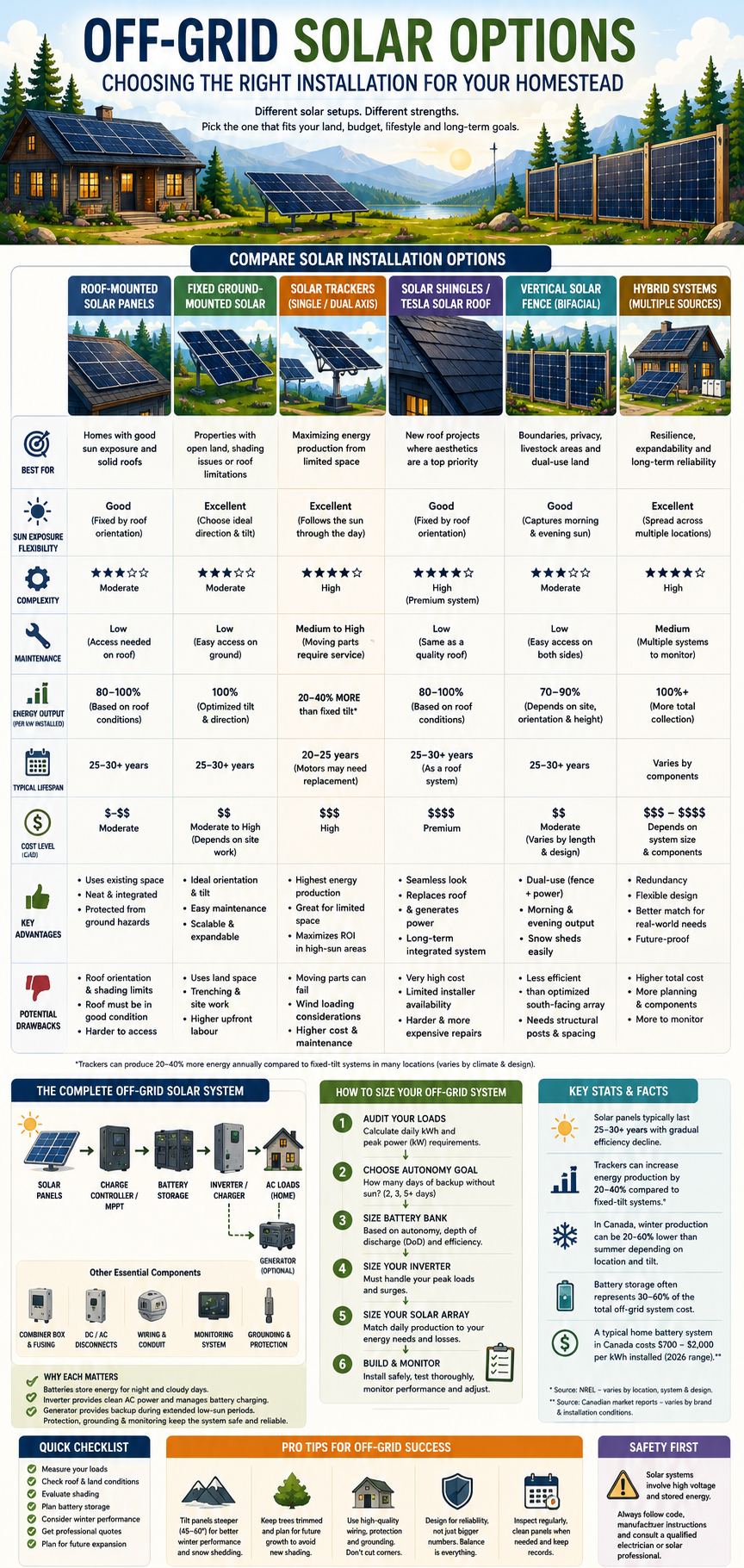
There is no single “best” solar installation for every property. A conventional roof-mounted array is usually the most practical choice for a home with a sound, sunny roof. A fixed ground mount is often better for rural properties with open land, shading issues, a poor roof orientation, or plans to expand later. Solar shingles are the premium aesthetic option, trackers are specialized production-maximizing equipment, and solar fences are emerging dual-use infrastructure rather than a replacement for a properly sized main array.
- Choose roof-mounted panels when your roof is in good condition, has useful sun exposure, and has enough unobstructed area.
- Choose fixed ground-mounted panels when you have land, want easy maintenance, and want to control orientation and tilt.
- Choose solar shingles or a Solar Roof when you already need a major roof replacement and aesthetics justify a premium integrated system.
- Choose a tracker when land is limited, sun exposure is excellent, and you accept more mechanical complexity.
- Choose a vertical solar fence when you also need a property boundary, privacy screen, livestock divider, or dual-use land feature.
- Choose a hybrid system when resilience matters most: for example, roof panels plus a ground array, batteries, critical-load circuits, and generator backup.
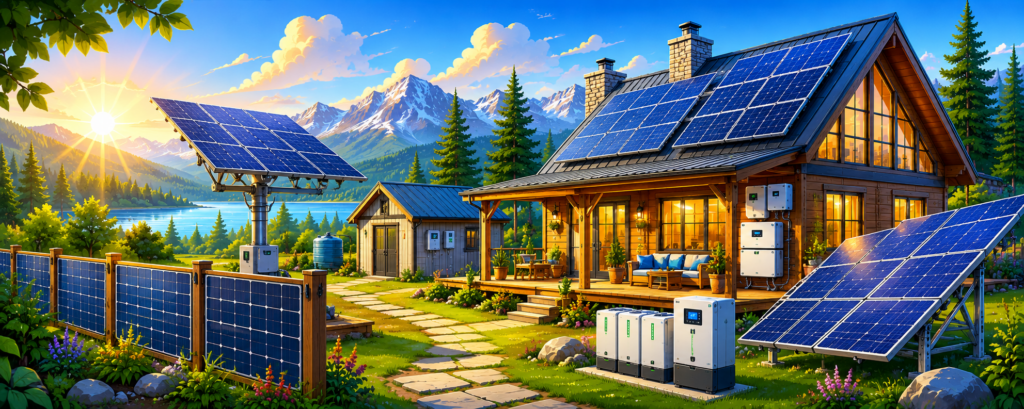
Start With the Whole Off-Grid System, Not the Panels
A solar array produces direct-current electricity, or DC power. Most homes use alternating-current electricity, or AC power, which means an inverter is needed to convert and manage that energy for normal household circuits and appliances. In an off-grid or backup-capable system, the inverter must be able to form and maintain its own local power supply rather than depending on the utility grid being present.
The basic system usually includes solar modules, mounting hardware, wiring, breakers and disconnects, an inverter or inverter-charger, battery storage, charge control or built-in maximum-power-point tracking, grounding, surge protection, and monitoring. Many systems also include a generator input so that a generator can recharge batteries or support large loads when solar production is weak. The Department of Energy notes that balance-of-system equipment in a stand-alone renewable-energy installation can account for as much as half of the total system cost, which is why a cheap panel price alone tells you very little about the real budget.
Before choosing a mounting style, complete a load audit. Record how much energy your household uses in kilowatt-hours per day, then separately identify the largest momentary loads in kilowatts. A fridge, lights, laptops, a water pump, and an efficient mini-split can often be handled very differently than electric baseboard heat, a conventional electric water heater, a clothes dryer, a large range, or EV charging. The off-grid mistake is buying panels based on roof space or a social-media setup photo, then discovering that the battery bank and inverter cannot actually support the way the household lives.
For Canadian properties, winter design matters more than summer bragging rights. A system that produces abundant energy in June may struggle in December when daylight is short, snow can remain on modules, and heating or lighting demand rises. Higher module tilt can help snow shed more quickly, although steeper tilt also increases wind loading and structural demands.
Off-Grid Solar Cost Snapshot in Canada
Solar costs vary sharply by province, access, equipment, labour availability, roof complexity, battery capacity, trenching, structural work, and whether the project is grid-connected, backup-capable, or fully off-grid. As a broad 2026 planning baseline, a conventional Canadian residential solar installation is often quoted around CAD $2.40 to $3.50 per watt before incentives; that places a 5 kW array roughly around CAD $12,000 to $17,500 and a 10 kW array around CAD $24,000 to $35,000. Those figures are useful for comparing panel-array quotes, but they do not represent the final cost of a full off-grid home system with substantial storage, power electronics, generator integration, and site work.
| Solar option | Typical cost level | Best use |
|---|---|---|
| Roof-mounted solar panels | Moderate | Homes with sound, sunny roofs |
| Fixed ground-mount solar | Moderate to high | Rural properties with open land |
| Solar trackers | High | Open sites where extra production justifies maintenance |
| Solar shingles / BIPV | Premium | New roof projects where appearance is a priority |
| Vertical solar fence | Custom / emerging | Dual-use boundaries, agricultural or privacy applications |
| Battery storage | Major system cost | Essential for true off-grid operation |
Battery storage deserves special attention because it is often the part that turns a standard solar project into an expensive resilience project. One Canadian market guide places installed home battery storage broadly around CAD $700 to $2,000 per kilowatt-hour, with wide variation by brand, capacity, system design, and installation conditions. That range is useful only as early-stage budgeting; a serious off-grid quote must be based on daily loads, battery autonomy goals, winter production, and the owner’s willingness to use backup generation.
Roof-Mounted Solar Panels: The Mainstream Home Option
Conventional roof-mounted panels are what most people picture first: photovoltaic modules attached to racking that is mechanically secured through the roofing system into the structural framing beneath. Proper installations use flashed attachment points, engineered racking, carefully routed wiring, and clear setbacks around roof edges, ridges, vents, and service access. On a good roof with limited shading, this is usually the cleanest and most efficient way to add solar without consuming yard space.
The major advantage is that the roof already exists as elevated, unused real estate. A south-facing roof plane is often ideal in the Northern Hemisphere, but east- and west-facing arrays can still be useful depending on the household’s production goals and daily power profile. Roof mounting also keeps modules above lawn equipment, livestock, children, and most accidental impacts. For suburban homes, it is often the only realistic option because there may not be enough open land for a ground array.
The downside is that roof conditions control the project. A roof that needs replacement soon should usually be replaced before solar goes on it, because removing and reinstalling panels later adds labour and complication. Shading from mature trees, chimneys, neighbouring buildings, vents, dormers, and satellite equipment can reduce output enough to make a roof array less attractive than a ground mount. Natural Resources Canada also stresses that the chosen photovoltaic system must not exceed the load for which the roof was designed, so structural review is not optional on questionable roofs or snow-heavy locations.
Choose roof-mounted solar if: your roof has plenty of sun, is structurally sound, has years of life left, and you want to preserve yard space. It is usually the best starting point for a typical house, garage, workshop, or cabin that has an uncomplicated roof form.
Fixed Ground-Mounted Solar: Often the Best Off-Grid Choice
A fixed ground-mounted array places panels on a purpose-built rack or frame at a chosen angle and orientation. For an off-grid property, this can be more practical than roof mounting because you can optimize the placement without being locked into the roof’s pitch or direction. A ground array can face the ideal direction, use a steeper winter-friendly tilt, sit clear of chimney and tree shadows, and be designed for future expansion.
Ground mounting also makes maintenance easier. You can inspect wiring, clear vegetation, wash heavy dirt when necessary, remove snow safely, and repair modules without climbing on a roof. This matters for homesteads where the owner may want to grow the system over time, add a workshop, build a second cabin, or eventually install a battery shed or generator enclosure. It also keeps expensive electrical equipment away from roof replacement work.
The trade-off is site work. Ground arrays need secure foundations, proper wire trenching, safe transitions into the building, protection from animals and equipment, and enough clearance for snow accumulation. Wind, frost heave, soil conditions, drainage, and local permit requirements all matter. Fixed-tilt systems generally have lower maintenance requirements than tracking systems, but they produce less energy per installed kilowatt because they do not follow the sun.
Choose fixed ground-mounted solar if: you have open land, want maximum control over orientation and tilt, expect to expand later, or have a shaded, poorly oriented, complex, or aging roof. For many serious rural off-grid projects, this is the strongest overall option.
Solar Trackers: More Production, More Moving Parts
Solar trackers rotate panels as the sun moves across the sky. A single-axis tracker generally follows the sun from east to west, while a dual-axis tracker can also adjust its angle through the seasons. The attraction is simple: when panels face the sun more directly for more hours of the day, they can produce more energy from the same installed panel capacity.
The problem is that a tracker is not just a solar rack. It is moving machinery with motors, controls, sensors, structural requirements, weather exposure, and more points of failure. Research from the National Renewable Energy Laboratory has found that tracking systems can increase output but also raise maintenance and equipment costs compared with fixed-tilt systems.
Trackers can be useful where land is limited, sun exposure is excellent, and the owner wants to maximize output from a constrained number of panels. They can also be helpful for specialized agricultural, commercial, or remote-site projects. In snowy climates, some trackers offer snow-stow features that tip modules to a steeper angle to encourage shedding, but those features should never replace structural design for the worst case where the tracker fails to move.
For most homes and cabins, a well-designed fixed ground array with a few additional panels is often the more reliable long-term decision. That is an engineering and maintenance judgment rather than a rule: a tracker can be excellent, but it should earn its extra complexity.
Choose a solar tracker if: panel area is genuinely limited, your site is wide open, you understand the maintenance trade-off, and an installer can demonstrate why the added production beats the added mechanical cost.
Solar Shingles and Tesla Solar Roof: Integrated but Premium
Solar shingles, often called building-integrated photovoltaics or BIPV, build electricity generation directly into the roof surface instead of mounting conventional panels above it. This is the visually cleanest option because the roof and solar system become one coordinated assembly. It is especially attractive for homeowners who dislike the appearance of rack-mounted modules or who are already planning a complete roof replacement.
Tesla Solar Roof is the most recognizable example. Tesla describes the product as a combination of glass solar tiles that generate electricity and architectural-grade steel roofing tiles that provide weather protection; not every tile is a power-generating tile. Tesla also states that Solar Roof is designed as a new roof system rather than a product simply placed over aging shingles, and it is commonly paired with Powerwall storage.
The benefit is obvious: a roof that produces power can look more integrated and intentional than a rack-mounted array. It may be especially appealing on a high-end custom home, architect-designed cabin, or major renovation where roofing, energy storage, and electrical upgrades are being planned together. The drawback is cost, complexity, product availability, and service support. Solar shingles are typically more expensive per watt than conventional panels, and a system should be budgeted as a premium roof plus premium solar rather than compared only against a basic shingle roof.
Choose solar shingles or Tesla Solar Roof if: you need a full new roof anyway, aesthetics matter heavily, and you are comfortable with a premium custom-project budget. Do not choose this simply because you assume it will be the cheapest way to go off-grid; conventional panels and a quality roof are usually easier to size, repair, and expand.
Vertical Solar Fences: Productive Boundaries, Not Magic Panels
Solar fences use vertically mounted photovoltaic modules as a fence, boundary, privacy screen, noise barrier, or agricultural divider. Many designs use bifacial panels, meaning both sides can collect light. A properly designed east-west-facing solar fence can produce one generation peak in the morning and another in the evening, which may line up better with household demand than a conventional south-facing array that peaks closer to midday.
This does not mean a solar fence captures sunlight “from all angles” or automatically beats a properly oriented main array. Its performance depends on orientation, spacing, shading, local latitude, reflection from the ground, panel height, and whether the project is optimized for annual energy, morning-evening output, farming access, or property-boundary use. Research on vertical bifacial systems suggests they can be valuable for dual land use, reduced soiling, easier access around farm machinery, and a different production profile—but their energy advantage is site-specific rather than universal.
For a homestead, a solar fence can be a smart secondary array. It might define a driveway, shelter a garden edge, separate livestock zones, provide privacy near a road, or turn a required boundary into something productive. However, it should be engineered as both a fence and an electrical structure. Wind loading, post foundations, wiring protection, animal contact, snow plowing, and local fence rules all need consideration.
Choose a solar fence if: you already need a durable boundary or screen and want productive infrastructure that complements a larger roof or ground array. Treat it as a strategic addition, not as your only power source unless a full site assessment proves otherwise.
Hybrid Solar Systems: The Most Resilient Approach
The strongest off-grid systems are often hybrids. A roof array may collect useful energy without using yard space, while a ground array can be aimed for better winter production and easier expansion. A small solar fence may add morning and evening output. Batteries can cover overnight use, while a generator can protect the system during prolonged dark weather, maintenance, or extraordinary loads.
This approach costs more at first, but it avoids putting every watt of production in the same physical location. If snow covers one roof plane, if a tree shades part of the property, or if a roof repair is needed, a diversified solar setup can keep more of the system productive. It also lets a homestead grow in stages instead of trying to fund the perfect forever system on day one.
A realistic staged plan might begin with a fixed ground array, inverter-charger, battery bank, critical-load panel, and generator connection. Later, roof-mounted panels could be added when a new roof is installed, or a small vertical bifacial fence could be added around a garden or driveway. The key is to plan conduit routes, electrical room space, battery location, and expansion capacity from the beginning.
Common Off-Grid Solar Mistakes to Avoid
- Buying panels before measuring loads: Daily energy use and peak power demand should determine array, battery, and inverter size.
- Confusing backup power with full off-grid power: Many grid-tied systems shut down during an outage unless designed with appropriate battery and grid-forming capability.
- Ignoring winter production: Design for the shortest, cloudiest, snowiest part of the year—not just summer output.
- Installing on an aging roof: Replace a tired roof before installing a long-life solar array over it.
- Underestimating batteries: Batteries, wiring, power electronics, protection equipment, and generator integration can cost as much as or more than the modules.
- Treating trackers as automatic upgrades: Extra production only matters if it outweighs the mechanical complexity, wind exposure, and maintenance burden.
- Skipping professional electrical and structural review: High-voltage DC wiring, battery storage, rooftops, and load calculations are not casual DIY work.
Final Thoughts: Choose the Installation That Fits the Property
The best solar option is the one that matches the building, land, climate, household loads, and long-term plan. Conventional roof panels are the practical default for many homes. Fixed ground mounts are often the best choice for rural off-grid properties. Solar shingles are premium integrated roof systems, trackers are specialized equipment for production-focused sites, and vertical solar fences are promising dual-use infrastructure with a different purpose than a standard array.
The smart order is simple: reduce energy waste, measure real loads, plan battery and inverter capacity, account for winter, then choose where the panels belong. Build the system around reliability first and aesthetics second. A flashy solar installation is interesting; a properly designed system that still powers the fridge, pump, lights, and essentials after several grey days is the one that actually earns its place on an off-grid homestead.
Related External Links
- Natural Resources Canada: Planning and Decision Guide for Solar PV Systems — A detailed Canadian reference for planning, sizing, and evaluating residential solar photovoltaic systems.
- Tesla Solar Roof — Official information on Tesla’s integrated glass solar tiles, steel roofing tiles, and Powerwall pairing.