
Home Heating Options: Fuels, Costs and Efficiency
Choosing how to heat a home is no longer as simple as deciding between a furnace and a wood stove. Homeowners can choose from natural gas, propane, heating oil, kerosene, firewood, pellets, heat pumps, outdoor boilers and even solar-assisted systems. Each option has a different balance of installation cost, fuel price, maintenance, comfort, reliability and environmental impact.
The cheapest fuel on paper is not always the least expensive heating system to own. A rural property without a natural-gas connection may face substantial hookup costs, while an older house may need electrical upgrades before supporting a whole-home heat pump. Firewood can be economical for someone with inexpensive wood and time to process it, but much less attractive when every cord must be purchased, delivered and stacked.
This guide compares the major home heating options available in Canada, with approximate Canadian-dollar planning ranges. Actual prices depend heavily on location, house size, insulation, contractor availability, fuel delivery and the equipment already installed. Before replacing a heating system, obtain a heat-loss calculation and several local quotes rather than choosing equipment based only on its advertised output.
Quick Answer: Which Heating System Is Best?
For homes with an existing natural-gas connection, a high-efficiency gas furnace or boiler often remains one of the least expensive conventional systems to operate. In areas with reasonably priced electricity, a properly sized cold-climate heat pump can be extremely competitive while also providing air conditioning. Rural homes may benefit from propane, wood, pellets or a dual-fuel arrangement, depending on fuel availability and the owner’s willingness to perform regular maintenance.
There is no universal winner, but these are useful starting points:
- Lowest-effort conventional option: Natural gas, where service is available
- Best heating-and-cooling combination: Cold-climate heat pump
- Best for an off-grid or wood-rich property: Certified wood stove or outdoor wood boiler
- Easier solid-fuel option: Pellet stove
- Common rural furnace fuel: Propane
- Useful existing-system option: No. 2 heating oil
- Best supplemental renewable option: Solar air heating
- Most limited modern residential option: Coal
Home Heating Options at a Glance
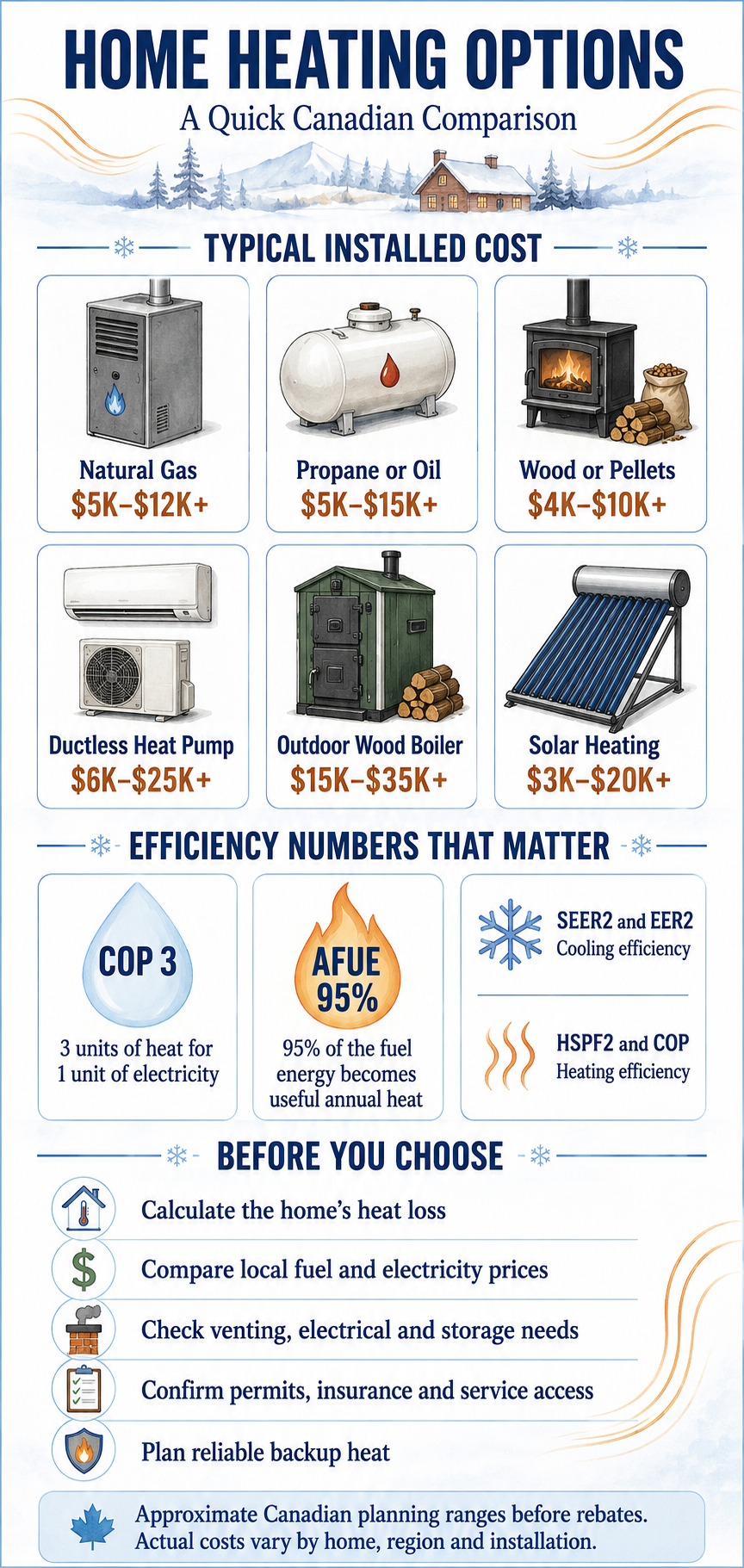
The following figures are broad 2026 Canadian planning ranges before rebates. They should not be treated as contractor quotes, since a chimney, fuel tank, electrical panel upgrade, duct modification or underground piping can change the final cost substantially.
| Heating option | Approximate installed cost | Operating-cost tendency | Main advantage | Main drawback |
|---|---|---|---|---|
| Natural-gas furnace or boiler | $5,000–$12,000+ | Low to moderate | Convenient and powerful | Requires gas service |
| Propane furnace or boiler | $5,000–$12,000+, plus tank | Moderate to high | Available in rural areas | Delivered fuel price can fluctuate |
| Oil or kerosene system | $6,000–$15,000+ | Moderate to high | Strong cold-weather output | Tank, delivery and spill concerns |
| Certified wood stove | $4,000–$10,000+ | Low to moderate | Works with local firewood | Labour, smoke and chimney maintenance |
| Pellet stove | $5,000–$10,000+ | Moderate | Automatic fuel feeding | Requires electricity and dry pellet storage |
| Coal appliance | $5,000–$12,000+ | Varies | Long, intense burns | Emissions, ash, insurance and limited availability |
| Ductless heat pump | $6,000–$8,000+ for one zone; $10,000–$25,000+ for multiple zones | Low to moderate | Efficient heating and cooling | Output falls in extreme cold |
| Outdoor wood boiler | $15,000–$35,000+ | Low if wood is inexpensive | Can heat several buildings | High installation cost and wood consumption |
| Solar air heating | $3,000–$8,000+ | Very low after installation | Simple supplemental heat | Only produces useful heat in suitable sunlight |
| Solar water or hydronic heating | $8,000–$20,000+ | Very low after installation | Can offset water or space heating | Complex and rarely supplies all winter heat |
Natural Gas and the LNG Question
Natural gas is delivered to most residential customers through underground pipelines. A gas furnace heats air distributed through ductwork, while a boiler heats water for radiators, baseboards or in-floor tubing. Modern condensing equipment can recover heat from water vapour in the exhaust, giving it better fuel utilization than older atmospheric equipment.
Liquefied natural gas, or LNG, is natural gas cooled to approximately −162°C so it occupies far less volume during storage and transportation. LNG is important to the energy industry, but an ordinary Canadian house generally does not keep LNG in a residential tank. The fuel may travel through the LNG supply chain, but by the time it reaches a typical connected house, it has been converted back into a gas and delivered by pipeline.
Natural gas is convenient, clean inside the home when equipment vents properly, and capable of producing substantial heat during severe cold. However, furnaces with electronic ignition, blowers and controls normally stop working during an electrical outage unless backup power is available. Gas service also carries monthly fixed charges, so the commodity price alone does not reveal the complete operating cost.

Propane and LPG Heating
LPG means liquefied petroleum gas, usually propane or a propane-butane mixture. In Canadian residential heating discussions, LPG and propane frequently refer to essentially the same fuel category rather than two completely separate heating options. Propane becomes a liquid under moderate pressure, allowing it to be stored in an outdoor tank and delivered to properties beyond the natural-gas network.
Propane furnaces and boilers operate similarly to natural-gas equipment, but they require the correct burner setup, regulator and fuel-storage system. Propane can also power fireplaces, cooktops, water heaters and generators, making it useful for rural properties that want one stored fuel for several purposes. Tanks may be rented from the supplier or purchased by the homeowner, and that decision can affect which companies are allowed to refill them.
The main weakness is price volatility. Propane is usually more expensive per unit of delivered heat than pipeline natural gas, although the difference varies by region and contract. Homeowners must also monitor tank levels, provide delivery access and follow clearance rules around tanks, ignition sources and buildings.
No. 2 Heating Oil and Kerosene
No. 2 heating oil is a middle-distillate petroleum product closely related to diesel fuel. It is commonly stored in a tank and burned in a forced-air furnace or hydronic boiler. Oil equipment delivers strong heat and performs reliably in cold climates, which explains why it remains common in parts of Atlantic Canada and in rural homes without natural-gas service.
Kerosene is a lighter petroleum distillate, sometimes associated with No. 1 fuel oil. It flows better at low temperatures and generally burns with less residue than heavier oil, but it usually costs more per litre. Kerosene is used in certain space heaters and appliances specifically designed for it; it should not be substituted for heating oil unless the equipment manufacturer permits the change.
An oil system’s disadvantages include fuel delivery, tank inspections, soot-producing combustion and the financial risk of a leak. Indoor tanks are protected from weather and temperature extremes but still require monitoring for corrosion, damaged lines and seepage. Outdoor tanks may need cold-weather consideration because heavier fuel can thicken or develop wax crystals.
Replacing a sound oil system solely because oil is unfashionable may not offer a quick payback. However, when the tank or furnace is nearing the end of its service life, comparing a cold-climate heat pump, propane system or hybrid heat-pump arrangement becomes much more compelling.
Hardwood Firewood
Firewood remains one of the most practical heating fuels for wooded rural properties. A modern certified wood stove can provide substantial heat without depending on a fuel-delivery truck, and certain models can operate during a power outage. The economics are especially favourable when the homeowner owns a woodlot or can purchase logs and process them safely.
Moisture content matters as much as wood species. Dense hardwoods such as maple, oak and beech contain more energy per stacked volume than many softwoods, but wet hardwood will still burn poorly. Firewood should be split, stacked off the ground and seasoned under cover with open sides until it reaches an appropriate moisture level for the appliance.
Wet wood wastes energy evaporating water, produces more smoke and encourages creosote formation in the chimney. Even dry wood creates fine-particle pollution, so the stove, connector pipe and chimney must be correctly installed and maintained. Health Canada notes that wood smoke contains particulate matter, carbon monoxide, volatile organic compounds and other pollutants, making certified low-emission equipment and proper operation important.
The true cost of wood includes more than the price of a cord. Cutting, splitting, hauling, stacking, chimney sweeping, ash handling and insurance requirements all belong in the calculation. Wood is economical for a willing owner with a suitable property, but it is not effortless heat.
Wood Pellets
Wood pellets are compressed pieces of processed wood fibre with relatively consistent dimensions and moisture content. A pellet stove uses an electric auger to feed fuel from a hopper into the burn pot, allowing steadier output and less manual attention than a cordwood stove. Many units use thermostatic controls and can operate for hours between refills.
Pellets are clean to handle compared with split firewood and require less storage volume for a similar amount of usable heat. However, bags must remain completely dry because damp pellets swell, crumble and can jam the feeding mechanism. Pellet quality also affects ash production and how frequently the stove needs cleaning.
Unlike a basic wood stove, most pellet appliances depend on electricity for the auger, combustion fan and control board. A blackout therefore stops normal operation unless the system has approved battery or generator backup. Before buying, homeowners should confirm reliable local pellet supplies rather than assuming bags will always be available during a winter shortage.
Bituminous and Anthracite Coal
Coal is now a niche residential fuel in Canada, but it is still worth understanding. Bituminous coal contains more volatile material, ignites relatively easily and can produce heavy smoke, soot and odour when burned poorly. Anthracite is harder, contains more fixed carbon and generally burns longer with less visible smoke, although it can be more difficult to ignite.
Neither type should be described as clean simply because anthracite can burn more steadily. Coal creates carbon emissions, ash and air pollutants, and the ash requires safe handling and disposal. Appliance selection is also critical because a wood stove is not automatically approved to burn coal.
Local bylaws, air-quality rules, insurance conditions and fuel availability may make residential coal impractical or prohibited. Anyone considering it should confirm all four before buying an appliance. In most modern homes, coal loses to heat pumps, gas or sustainably sourced wood on convenience and availability even when its raw energy density appears attractive.
Ductless Mini-Splits and Heat Pumps
A mini-split is not a fuel; it is an electrically powered heat-pump system. The outdoor unit absorbs low-temperature heat from the air, a compressor raises the refrigerant’s pressure and temperature, and an indoor unit releases that heat into the building. A reversing valve allows the cycle to operate in the opposite direction for summer cooling.
Because a heat pump moves heat rather than creating all of it through electric resistance, it can deliver multiple units of heat for each unit of electricity consumed. Natural Resources Canada explains that performance and heating capacity decline as outdoor temperatures fall, which is why correct cold-climate equipment selection and sizing matter. The temperature at which the house loses heat as quickly as the unit can supply it is called the thermal balance point.
A single-zone mini-split is useful for a workshop, addition, open-plan living area or house with an existing backup system. Multi-zone installations use several indoor heads, but bedrooms with closed doors and complicated floor plans can be difficult to heat evenly. More heads do not automatically produce a better design; sometimes several smaller outdoor systems provide better turndown, redundancy and cold-weather performance than one oversized multi-zone unit.
Cold-climate heat pumps can continue operating at temperatures well below freezing, but “operates at” is not the same as “delivers full rated output efficiently.” Homeowners should compare the unit’s capacity and coefficient of performance at low temperatures, not only its warm-weather ratings. Electric resistance, a furnace, a boiler or a wood stove may still serve as backup during extreme cold or equipment failure.
Understanding EER, SEER, HSPF and COP
Heating and cooling labels contain several ratings that are easy to confuse. Comparing only the largest number on the brochure can lead to poor decisions because each rating measures something different.
- EER or EER2: Cooling output divided by electrical input at a specified test condition. It represents efficiency at one operating point.
- SEER or SEER2: Seasonal Energy Efficiency Ratio. It estimates cooling efficiency over an entire cooling season.
- HSPF or HSPF2: Heating Seasonal Performance Factor. It estimates heat-pump efficiency across a heating season.
- COP: Coefficient of Performance. A COP of 3 means the system delivers three units of heat for every unit of electricity consumed at that test condition.
- AFUE: Annual Fuel Utilization Efficiency. It estimates the portion of a furnace or boiler’s fuel energy converted into useful annual heat.
SEER2 and EER2 primarily describe cooling, not Canadian winter performance. When heating is the priority, examine HSPF2, low-temperature COP and the unit’s available heating capacity at the design temperature for the area. A qualified designer should also perform a room-by-room or whole-building heat-loss calculation rather than sizing equipment from floor area alone.
Outdoor Wood Boilers
An outdoor wood boiler, also called an outdoor wood furnace or outdoor hydronic heater, burns wood in an exterior enclosure. It heats water or a water-antifreeze mixture that circulates through insulated underground piping to a heat exchanger inside the house. One unit may also heat a garage, workshop, domestic hot-water tank or another nearby building.
Keeping combustion and wood debris outside is attractive, but the system has significant infrastructure. The owner needs an appropriately located boiler, buried insulated lines, pumps, controls, heat exchangers and a large dry wood supply. Poor underground piping can lose a surprising amount of heat into the soil, eroding the system’s economy.
Older outdoor boilers gained a poor reputation for smoke because some operated with low firebox temperatures and long smouldering cycles. Modern certified gasification-style units can burn more efficiently, but they still require seasoned fuel, correct loading and regular maintenance. Local setback, chimney, emissions and insurance requirements must be checked before installation.
Solar Air and Solar Water Heating
Solar air heaters use sunlight to warm air inside a collector, after which a fan moves the heated air into the building. They are comparatively simple and can work well on a sunny wall of a workshop, garage or home. Their limitation is timing: they produce the most heat when sunlight is available, not necessarily during the coldest night.
Solar thermal water systems transfer heat from collectors into domestic hot water, a storage tank or a hydronic heating system. In a freezing climate, they generally require appropriate freeze protection, controls and provisions for excess summer heat. Solar-assisted space heating works best with a well-insulated building, substantial thermal storage and low-temperature emitters such as radiant floors.
Neither solar approach should automatically be treated as a complete Canadian winter heating system. Solar is usually most successful as a supplement that reduces the workload on another reliable heat source. The building’s orientation, shading and winter solar exposure should be evaluated before equipment is purchased.
How to Compare Real Heating Costs
The cleanest comparison is the cost of delivered heat, not the price of a litre, bag, cubic metre or kilowatt-hour. Each fuel contains a different quantity of energy, and each appliance converts a different percentage of that energy into usable heat.
For a combustion system, use this basic formula:
Cost per delivered kWh = fuel price per unit ÷ (energy per unit × appliance efficiency)
For a heat pump, divide the electricity rate by its COP. At a hypothetical all-in electricity price of $0.15 per kWh, a resistance heater costs $0.15 per delivered kWh. A heat pump averaging a COP of 3 would theoretically deliver heat for about $0.05 per kWh, while a COP of 2 would raise that figure to approximately $0.075.
This comparison still needs context. Natural gas bills include fixed charges, wood prices may exclude delivery, and heat-pump performance changes with weather. A house with poor air sealing can also consume so much energy that changing fuels merely disguises the larger problem.
Safety and Installation Considerations
Any fuel-burning appliance can create carbon monoxide if combustion or venting fails. Homes with combustion equipment should have correctly placed, approved carbon-monoxide and smoke alarms. Furnaces, boilers, stoves, chimneys, fuel lines and tanks also need inspections at intervals appropriate to the equipment and local requirements.
Heat pumps avoid indoor combustion but still involve high-voltage wiring, refrigerant handling, condensate management and structural mounting. A bargain installation can suffer from leaking flare connections, poorly supported line sets, drainage problems or inadequate low-temperature capacity. DIY installation may also affect certification, warranty coverage, insurance and eligibility for incentives.
Before choosing a system, confirm:
- The home’s calculated design heat loss
- Electrical-service and panel capacity
- Chimney or venting requirements
- Fuel storage and delivery access
- Local bylaws, permits and setbacks
- Insurance-company requirements
- Qualified service availability
- Backup heat and outage plans
- Current rebates and financing programs
What Is the Best Home Heating Option?
A cold-climate heat pump is increasingly attractive when a house needs both heating and air conditioning, especially when replacing electric resistance, oil or expensive propane heat. Natural gas remains practical where the infrastructure already exists and local gas prices are favourable. Wood and outdoor boilers suit owners with land, inexpensive fuel and a realistic tolerance for physical work.
Pellets provide more automation than cordwood but remain dependent on electricity and a stable fuel supply. Oil and propane offer dependable high-output heat, although delivered fuel prices and tank responsibilities can make operating costs unpredictable. Coal has become a specialized choice with substantial practical and environmental disadvantages, while solar heating works best as a supplement.
The smartest decision is often a combination rather than a single technology. A heat pump paired with an existing furnace, boiler or wood stove can reduce annual fuel consumption while preserving backup capacity for extreme cold and outages. Whatever the system, improving insulation and air sealing first can lower the required equipment size and continue saving money regardless of which fuel becomes more expensive next.
- Natural Resources Canada: Heating and Cooling With a Heat Pump — Learn how air-source heat pumps transfer heat, operate in cold weather and handle heating, cooling and defrost cycles.
- Health Canada: Wood Smoke and Indoor Air Quality — Review the health effects of wood smoke and practical guidance for safer residential wood heating.