
Types of Insulation: R-Values, Costs and Best Uses
Insulation appears simple until you stand in a building-supply aisle facing batts, bags, rigid boards and spray-foam kits that all promise lower energy bills. The labels may emphasize R-value, but thermal resistance is only one part of a successful building assembly. Moisture exposure, air leakage, fire protection, available space and installation quality can matter just as much as the number printed on the package.
Fiberglass may be the economical choice for an open stud wall, while rigid foam is often more appropriate against concrete or beneath a slab. Mineral wool performs particularly well where fire resistance, sound control and dimensional stability matter. Spray polyurethane foam can insulate and air-seal irregular cavities, but it costs considerably more and is less forgiving of installation errors.
The goal is not to identify one universally superior product. It is to match the insulation’s physical properties to the part of the building where it will be installed. By the end of this guide, you should understand what R-value means, how the major insulation materials differ, what they approximately cost in Canada and where each product makes the most sense.
Quick Answer: Which Insulation Should You Use?
For accessible wood-framed walls, fiberglass remains the budget option, while mineral wool offers easier friction-fitting, better sound absorption and strong fire resistance at a higher price. Blown cellulose is well suited to attic floors and existing enclosed walls, provided moisture problems have already been corrected. Rigid foam works best where continuous insulation, contact with concrete or limited thickness makes batt insulation impractical.
Open-cell spray foam can fill large dry cavities and create an air barrier when installed correctly, but it remains vapour permeable. Closed-cell spray polyurethane foam provides more R-value per inch, resists moisture movement and adheres to irregular surfaces, making it useful at rim joists, masonry and other difficult transitions. It is also one of the most expensive options and usually belongs in the hands of a qualified installer.
A practical starting guide is:
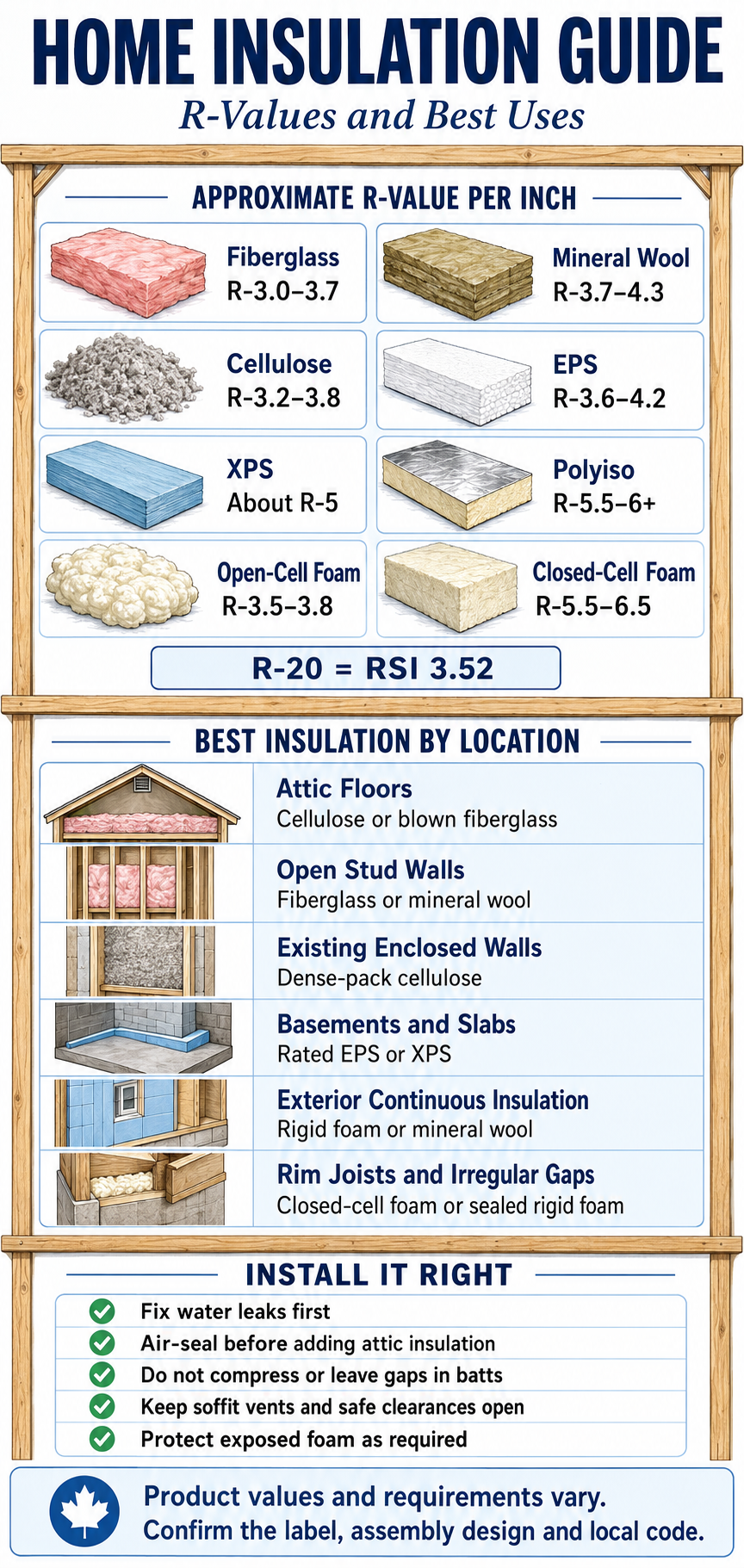
- Open stud walls: Fiberglass or mineral-wool batts
- Attic floors: Blown cellulose or blown fiberglass
- Existing enclosed walls: Dense-pack cellulose or blown fiberglass
- Exterior continuous insulation: EPS, XPS, polyiso or rigid mineral wool
- Basement concrete walls: Suitable rigid foam or professional closed-cell spray foam
- Under concrete slabs: Load-rated EPS or XPS approved for the application
- Rim joists and irregular gaps: Cut-and-cobble rigid foam or closed-cell spray foam
- Sound-sensitive partitions: Mineral wool or sound-control fiberglass
- Small air leaks: One-part canned polyurethane foam or sealant—not cavity insulation
What Does R-Value Mean?
R-value measures resistance to heat flow. A larger number indicates that a material resists conductive heat transfer better than a lower number. R-values can generally be added when compatible layers are installed together, so R-10 exterior foam combined with an R-20 insulated cavity provides roughly R-30 in the insulated portion of the assembly.
Canada also uses the metric RSI system. To convert imperial R-value to RSI, divide the R-value by approximately 5.678. R-20, for example, is approximately RSI 3.52; converting in the other direction requires multiplying RSI by 5.678.
The advertised value of the insulation is not necessarily the effective R-value of the complete wall or roof. Wood and steel framing conduct heat more readily than insulation, creating pathways called thermal bridges. A nominal R-20 batt wall can therefore have a noticeably lower whole-wall R-value once studs, plates, headers and other structural components are included.
Installation quality also changes performance. A batt compressed behind wiring, folded around a pipe or cut too small leaves areas with less thermal resistance. Gaps can permit air circulation around the insulation, while wind entering through a poorly detailed exterior layer can reduce the effectiveness of air-permeable products.
R-value does not automatically indicate whether a material is an air barrier, vapour retarder, drainage layer or ignition barrier. Those are separate functions, even when one product can perform several of them. A durable building enclosure needs coordinated control of heat, air, water and water vapour—not just a thick layer of insulation.
Insulation R-Values and Approximate Costs
The following values and costs are general Canadian planning ranges. Product density, facing, thickness, location, job size and labour conditions can produce substantial differences. Cost ranges are not normalized to the same finished R-value, so they should be used for preliminary comparison rather than final estimating.
| Insulation type | Approximate R-value per inch | Rough Canadian cost tendency | Best-known application |
|---|---|---|---|
| Fiberglass batt | R-3.0 to R-3.7 | $0.75–$1.75/sq. ft. material | Open walls, floors and ceilings |
| Mineral wool | R-3.7 to R-4.3 | $1.50–$3.50/sq. ft. material | Fire, sound and exterior walls |
| Cellulose | R-3.2 to R-3.8 | $1.50–$3.50/sq. ft. installed | Attics and enclosed cavities |
| EPS rigid foam | R-3.6 to R-4.2 | $0.70–$1.75/sq. ft. per inch | Foundations, slabs and exterior insulation |
| XPS rigid foam | About R-5 | $1.50–$2.50/sq. ft. per inch | Below-grade and high-load applications |
| Polyiso board | About R-5.5 to R-6+ | $1.50–$3.00/sq. ft. per inch | Above-grade walls and roofs |
| Open-cell spray foam | R-3.5 to R-3.8 | $1.50–$3.50/sq. ft., depending on depth | Large, dry framed cavities |
| Closed-cell spray foam | About R-5.5 to R-6.5 | $3.00–$8.00+/sq. ft., depending on depth | Rim joists, masonry and limited space |
Professional jobs may include minimum service charges, removal of existing insulation, air sealing, ventilation work, access preparation or required protective finishes. Those items can cost more than the insulation itself. Always compare quotes using the same finished R-value, coverage area and scope of work.
Fiberglass Insulation
Fiberglass is manufactured from fine glass fibres and is sold as batts, rolls or loose-fill material. It remains popular because it is widely available, relatively inexpensive and easy to install in conventional framing. Pre-cut batts are commonly sized for standard stud and joist spacing.
Fiberglass works by trapping small pockets of air, so crushing it undermines its insulating ability. Batts should fill the entire cavity without gaps, folds or excessive compression. Around electrical cables, the batt should be carefully split so insulation sits behind and in front of the cable rather than being pushed into a lump.
Kraft-faced and foil-faced products can change the assembly’s vapour characteristics and must face the appropriate direction for the climate and wall design. Unfaced batts do not stop airflow, which means a separate, continuous air-barrier system is normally required. Fiberglass is also not a suitable solution for an actively wet basement wall.
Wear gloves, long sleeves, eye protection and an appropriate dust mask or respirator while cutting and handling fiberglass. A straightedge and insulation knife help create clean cuts around boxes and framing. Do not place insulation against heat-producing equipment unless the appliance and insulation instructions specifically permit it.
Mineral Wool or Rock Wool
Mineral wool is made from spun stone or industrial mineral material and is commonly sold as dense batts or rigid boards. “Rock wool” and “stone wool” are frequently used as names for this category. Its greater density allows batts to friction-fit securely between studs and remain dimensionally stable.
The material is non-combustible and tolerates high temperatures better than plastic foam. It also absorbs sound effectively, which makes it a strong choice for bedroom partitions, mechanical rooms, home theatres and walls separating living space from a garage. Rigid mineral-wool boards can provide continuous exterior insulation while remaining relatively vapour open.
Mineral wool generally costs more than fiberglass and can be harder on cutting tools. Batts must still be trimmed accurately around wiring, pipes and electrical boxes. The fibres can irritate skin and lungs, so similar protective equipment is required during installation.
It is not waterproof, even though it typically drains and dries more readily than many fibrous products. A wall or roof still needs effective bulk-water management. Mineral wool should not be used as an excuse to ignore a foundation leak, failed flashing or roof defect.
Cellulose Insulation
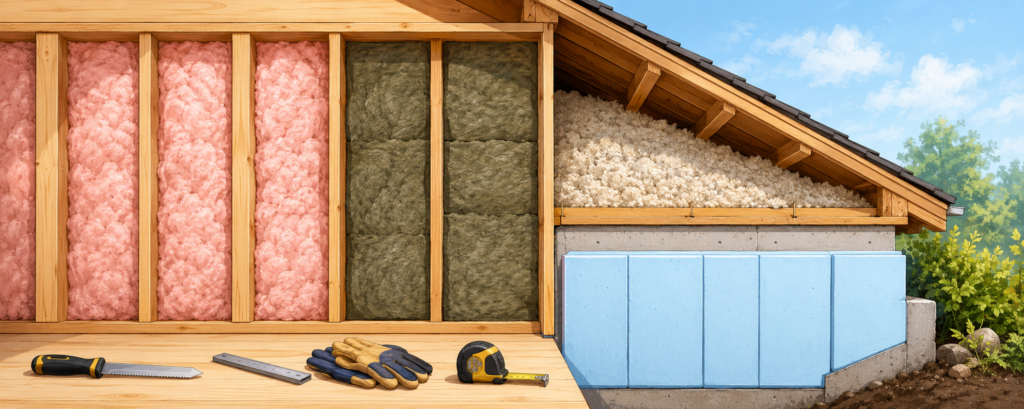
Cellulose insulation is usually manufactured from recycled paper fibre treated for fire and pest resistance. It is commonly blown loose across attic floors or dense-packed into enclosed walls. The small fibres settle around obstructions more effectively than pre-cut batts, making cellulose useful in irregular existing cavities.
Loose-fill attic cellulose must be installed to the specified depth and density because some settling is expected. Attic rulers help show the finished depth, but coverage and bag-count instructions remain important. Before blowing insulation, air leaks around wiring penetrations, plumbing stacks, top plates and ceiling fixtures should be sealed.
Dense-packing existing walls requires suitable equipment and experience. Too little material can settle and leave an empty area at the top, while uncontrolled pressure can damage weak plaster or drywall. Electrical hazards, concealed moisture and blocked wall cavities should be investigated before drilling access holes.
Cellulose should remain separated from unsafe heat sources and should not bury fixtures that are not approved for insulation contact. Attic ventilation components, including soffit baffles, must remain functional. A professional assessment is sensible when the attic contains vermiculite, mould, animal contamination or obsolete wiring.
EPS, XPS and Polyiso Rigid Foam
Rigid foam boards provide continuous insulation across studs or masonry, reducing thermal bridging that cavity insulation cannot address. They can be cut with common tools, but the seams, edges and penetrations must be detailed according to the assembly design. Depending on the product and taped-joint system, rigid foam may contribute to the air, vapour or water-control layers.
Expanded Polystyrene
Expanded polystyrene, or EPS, is the familiar bead-type foam used in foundations, walls, insulated concrete forms and beneath slabs. It usually provides approximately R-3.6 to R-4.2 per inch, although enhanced graphite products can be higher. EPS tends to be more vapour permeable than XPS at comparable thicknesses and is often the least expensive rigid-foam option.
Different densities have different compressive strengths, so an ordinary wall board should not automatically be installed beneath a slab or footing. Use a product rated for the structural load and exposure. Below-grade joints and terminations must also be designed to control soil moisture, groundwater and insects.
Extruded Polystyrene
Extruded polystyrene, or XPS, is a denser closed-cell board commonly recognized by its coloured surface. It generally provides about R-5 per inch and offers good moisture resistance and compressive strength. Those characteristics make it common on foundation exteriors, beneath slabs and in other demanding locations.
XPS usually costs more than basic EPS. Its environmental impact also varies with the blowing-agent technology used by the manufacturer, so newer lower-impact products may be preferable. As with any plastic foam, exposed interior surfaces normally require an approved protective covering.
Polyisocyanurate
Polyisocyanurate, normally shortened to polyiso, offers one of the highest advertised R-values per inch among rigid boards. It is frequently faced with foil or fibreglass and used on above-grade walls and roofs. Foil-faced products can be highly resistant to vapour movement and may also serve as part of an air-barrier system when joints are properly detailed.
Polyiso’s performance can change with temperature, and cold-weather R-value deserves attention in Canadian construction. Its design value should be based on appropriate long-term thermal resistance rather than only a favourable initial rating. For very cold or continuously wet applications, EPS, XPS, rigid mineral wool or another assembly may be more suitable.
Open-Cell Versus Closed-Cell Spray Foam
Both open-cell and closed-cell spray foams are forms of spray polyurethane foam created by mixing reactive components at the nozzle. The liquid expands and bonds to surrounding materials, allowing it to fill shapes that are difficult to insulate with boards or batts. The finished products, however, behave differently.
Open-cell foam is softer, lighter and expands dramatically. It provides approximately R-3.5 to R-3.8 per inch and can fill a large framed cavity with less material. It can form an air barrier at the required installed thickness, but it remains relatively vapour permeable and should not be treated as a moisture barrier.
Closed-cell foam is denser and typically provides roughly R-5.5 to R-6.5 per inch. Natural Resources Canada describes closed-cell polyurethane as a high-value product that can function as an air barrier and, at sufficient thickness, may also provide substantial vapour resistance. It is useful where space is restricted or where the insulation must adhere to masonry, framing and irregular transitions.
Closed-cell foam is much more expensive and can restrict drying if placed in the wrong assembly. Neither foam repairs a roof or foundation leak; spraying over damp materials may conceal rather than solve the problem. Roof sheathing, masonry and framing should be evaluated before foam is used to create an air-impermeable layer.
Two-component professional foam depends on substrate temperature, chemical temperature, pressure, mixture ratio and installer technique. Incorrectly processed foam may shrink, pull away, remain soft or produce a persistent odour. Occupants and other trades must follow the manufacturer’s re-entry requirements, and the cured foam commonly requires an approved thermal or ignition barrier.
What About Canned Polyurethane Foam?
One-part canned foam is useful for sealing narrow gaps around penetrations, sill plates, plumbing and certain window or door frames. Low-expansion products should be used around windows and doors so the curing foam does not distort the frames. Fire-blocking products must be used only where their listing and local requirements allow.
Canned foam is not an economical substitute for full-cavity spray foam. A bead around the perimeter of a rigid board can help create a cut-and-cobble rim-joist assembly, but the details must remain continuous. Large openings usually need solid backing or rigid insulation before the edges are sealed.
Best Insulation by Location
Attics
For a conventional vented attic, air sealing the ceiling plane followed by blown cellulose or blown fiberglass is often the most cost-effective approach. Baffles must protect soffit ventilation, and insulation should remain clear of incompatible heat sources. Spray foam at the roof deck changes the attic into a different enclosure strategy and should not be improvised without considering moisture, ventilation and roofing requirements.
Basements and Rim Joists
Concrete can transmit ground moisture, making an ordinary fiberglass batt pressed against a foundation wall a risky arrangement. Suitable rigid foam or professionally installed closed-cell spray foam can separate moisture-sensitive framing from the concrete. Natural Resources Canada’s basement guidance describes hybrid assemblies that combine a continuous foam layer with a framed, batt-insulated wall.
Rim joists contain numerous joints and penetrations, so air sealing matters greatly. Cut rigid foam sealed around its perimeter can be a practical DIY method, while closed-cell spray foam handles complex geometry more easily. Termites, fire protection and required clearances should be considered before concealing the area.
Exterior Walls
Fiberglass, cellulose and mineral wool all work in framed cavities when the air and moisture-control layers are properly detailed. Exterior continuous insulation improves whole-wall performance by covering thermal bridges. The foam thickness, vapour permeance and location must be coordinated so the wall can manage winter condensation and dry in a safe direction.
Sheds, Garages and Workshops
A heated shed or workshop can use fiberglass or mineral wool between studs, but only after the structure has effective roof and wall weather protection. Mineral wool is attractive near noisy equipment and in fire-conscious assemblies, while rigid foam can improve thin walls or metal buildings. Any exposed foam needs the protection required for the building’s use and local regulations.
Occasionally heated buildings are prone to condensation because the indoor temperature changes quickly while exterior surfaces remain cold. Air sealing and vapour control therefore matter even when the building is not occupied continuously. Insulating a damp, unventilated shed can simply move condensation into a hidden cavity.
Common Insulation Mistakes
The most expensive insulation can still perform badly when installed carelessly. Several mistakes appear repeatedly in renovations:
- Insulating before repairing roof, plumbing or foundation leaks
- Leaving air leaks beneath thick attic insulation
- Compressing or folding fiberglass batts
- Installing batts around rather than behind wiring
- Blocking soffit vents or covering unsafe fixtures
- Leaving gaps between rigid boards
- Creating an unintended double vapour barrier
- Spraying foam on wet, dirty or excessively cold surfaces
- Leaving combustible foam exposed
- Choosing insulation before calculating the required R-value and assembly thickness
A vapour barrier should not be added automatically because “more protection” sounds safer. Two low-permeance layers can trap moisture between them. Confirm the intended wall or roof design, local climate requirements and product specifications before changing an existing assembly.
DIY Installation or Professional Work?
Batts and accessible rigid boards are realistic DIY projects for someone who measures carefully and uses proper protective equipment. Small air-sealing jobs can also produce excellent results when penetrations are identified before insulation is added. Blower rentals make loose-fill attic projects possible, although maintaining even depth and safe clearances usually requires at least two people.
Dense-pack walls and large spray-foam projects demand more specialized knowledge. Professional installers can assess cavity conditions, control density or chemical processing and document the finished work. The lowest quotation is not necessarily the best value if it omits air sealing, preparation, cleanup or required fire protection.
Before starting, inspect for asbestos-containing materials, vermiculite, mould, animal waste and unsafe wiring. Do not disturb suspicious material until it has been professionally assessed. Wear suitable respiratory, eye and skin protection, and follow the product’s safety data and installation instructions.
Choosing Insulation by Performance, Not Hype
The best insulation is the product that delivers the required thermal resistance while managing air, moisture, fire risk, space and cost within a properly designed assembly. Fiberglass offers economical cavity insulation, mineral wool adds density and fire performance, and cellulose excels in attics and retrofit cavities. Rigid foam reduces thermal bridging and handles locations where fibrous insulation is unsuitable.
Open-cell spray foam fills large dry cavities and air-seals, while closed-cell polyurethane provides more R-value per inch and stronger moisture resistance at a premium price. EPS, XPS and polyiso each occupy a different position in the rigid-board market rather than serving as interchangeable coloured sheets. Their compressive strength, facings, vapour permeance and temperature performance must match the application.
Start by fixing water problems and identifying the home’s heat, air, vapour and drainage layers. Then compare materials at the same finished R-value and include labour, preparation, protective coverings and long-term serviceability. A thoughtfully installed moderate-cost insulation system will outperform an expensive product placed in the wrong assembly.
- Natural Resources Canada: Insulation and Air-Sealing Materials — Review Canadian guidance on insulation materials, R-values, air barriers and vapour-control products.
- ENERGY STAR: Choosing the Appropriate Insulation Type — Compare insulation formats, suitable applications and the installation skill required for each type.