
Build a Yard That Feels Like a Retreat
Some backyards feel like leftover space. They have grass, maybe a plastic chair, a barbecue, a few tools leaning against the fence, and enough potential to be frustrating. You look at the yard and know it could be something better, but the problem is not always obvious. It is not just missing furniture. It is missing atmosphere.
Then you visit a spa, resort, cottage property, or well-designed patio and the difference hits you immediately. There are warm lights along the pathway, wood textures, seating zones, privacy, soft shadows, and little details that make the space feel intentional. Nothing has to be wildly expensive. The magic usually comes from layers.
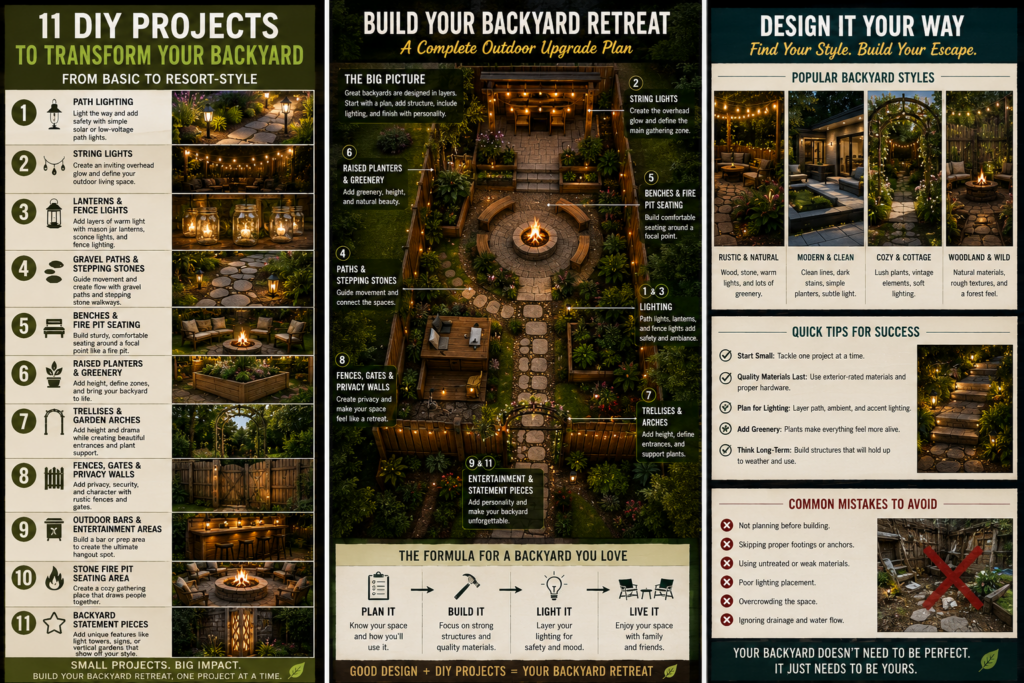
That is the real secret behind most beautiful outdoor spaces. A backyard that feels like a resort is usually not built from one giant project. It is built from several smaller upgrades that work together: lighting, pathways, seating, privacy, structure, greenery, and focal points. When those pieces line up, even a normal backyard starts feeling like an outdoor room instead of an empty patch of land.
The good news is that many of these upgrades are very DIY-friendly. You can build wooden pathway lights, string light poles, benches, trellises, privacy walls, garden gates, fire pit seating, and stone paths without hiring a full landscape crew. Some projects take one afternoon. Others require a weekend. A few demand real planning, measuring, digging, and structural thinking.
This guide ranks DIY backyard resort upgrades by difficulty so you can start where you are. If you only have a drill, saw, shovel, and basic supplies, there are still projects here that can completely change the mood of your yard. If you are more confident with woodworking or masonry, the harder projects can turn your backyard into something that feels genuinely custom.
Before we rank the projects, here is the overall idea: resorts do not just decorate outdoor spaces. They guide people through them. They use light, pathways, seating, privacy, and focal points to create a feeling.
This visual group shows the core pieces that make a backyard feel designed instead of random: warm lighting, built seating, pathways, and rustic structures.
What Makes a Backyard Feel Like a Resort?
A resort-style backyard is not necessarily fancy. It does not need marble, a pool, or expensive furniture. What it needs is intention. Every part of the space should feel like it belongs there.
The biggest difference is usually zoning. A plain backyard is one big open area. A better backyard has sections: a seating area, a cooking area, a walking path, a fire pit zone, a shaded corner, and maybe a quiet garden or reading spot. Even small yards can feel larger when they are divided into purposeful areas.
Lighting is the second major ingredient. Warm lighting changes everything because it extends the backyard into the evening. A yard that looks average in daylight can feel magical at night with string lights, pathway lights, lanterns, and small accent lights hidden near trees or fences.
Texture also matters. Wood, stone, gravel, brick, plants, fabric, and metal all create visual richness. A backyard with only grass and plastic furniture feels thin. A backyard with wood benches, gravel paths, stone borders, warm light, and plants feels layered.
That is why DIY backyard upgrades are so powerful. You are not just adding objects. You are building atmosphere.
Difficulty 1: Solar Path Lights and Quick Lighting Fixes
The easiest resort-style upgrade is lighting. This is where most people should start because it gives instant results with very little construction. Solar path lights, clip-on deck lights, lanterns, and warm LED accents can change a yard in one evening.
The key is choosing warm lighting rather than harsh white lighting. Warm LEDs around 2700K to 3000K usually feel softer and more relaxing. Cold white lights can make a yard feel like a parking lot, which is the opposite of the resort effect.
Solar lights are useful because they require no wiring. You can place them along pathways, garden edges, fence lines, stairs, or near seating areas. They are not always the most powerful option, but they are simple, affordable, and beginner-friendly.
A quick beginner project is to place solar lights inside simple wooden holders. Cut short square posts or scrap wood blocks, drill or notch the top to hold the solar light, sand the edges, stain the wood, and place them beside a pathway. This gives cheap solar lights a custom-built look.
This project is easy, but do not underestimate it. Path lighting is one of the fastest ways to make a backyard feel intentional. This Old House recommends spacing path lights to create gentle pools of light rather than blasting the entire walkway, which is exactly the kind of subtle effect that makes outdoor spaces feel more polished.
Difficulty 2: String Light Poles and Overhead Glow
String lights are popular for a reason. They create overhead atmosphere, define a gathering zone, and instantly make a patio, deck, or fire pit area feel more inviting. Home Depot Canada notes that string lights can be run like a canopy over a patio or deck to create warm, even backyard lighting.
The DIY version is straightforward. You can install wooden posts in planters, attach lights to fence posts, run them between trees, or build freestanding poles around a seating area. The goal is not just illumination. The goal is to create a ceiling of light.
For a simple version, use pressure-treated posts set into large planters or buckets filled with concrete. Add hooks near the top, string outdoor-rated lights between the posts, and place the system around a patio, barbecue area, or fire pit seating zone. This creates the feeling of an outdoor room without building a roof.
The mistake people make is hanging string lights too randomly. If the lines sag awkwardly, attach to weak supports, or cross the yard without purpose, they can look messy. Keep the layout intentional: a rectangle, triangle, zigzag canopy, or straight line over a table.
This is still an easy project, but it gives a huge payoff. If your backyard currently feels empty, overhead string lights can make it feel like a destination almost immediately.
Difficulty 3: Mason Jar Lanterns, Hanging Lights, and Fence Lighting
Once the main lighting is handled, smaller lantern projects add detail. Mason jar lanterns, hanging solar lights, fence-mounted sconces, and small LED accents help create layers of light. Resorts rarely use one light source. They use multiple soft light sources at different heights.
A simple DIY lantern can be made with mason jars, battery-powered fairy lights, wire handles, and hooks. Hang them from a trellis, fence, pergola, tree branch, or shepherd’s hook. For a more rugged DIY look, mount jars inside small scrap wood frames.
Fence lighting is another strong project. Attach small solar lights or low-voltage fixtures along a fence line to create depth at night. This works especially well if the fence is dark stained wood because the warm light reflects off the surface and creates a cozy glow.
You can also build small wooden lantern boxes from scrap wood. Create a simple rectangular frame, leave openings on the sides, place a solar puck light or battery candle inside, and stain the exterior. These can sit on steps, tables, posts, or garden edges.
This level of lighting is where a backyard starts feeling intentionally designed. The main string lights create the ceiling. Path lights guide movement. Lanterns create mood.
Difficulty 4: Gravel Paths and Stepping Stone Walkways
A backyard feels more expensive when it has movement. Pathways guide the eye and tell people where to go. Even a small stepping stone path can make a yard feel designed instead of accidental.
This is where simple masonry and landscaping work enter the picture. You do not need to pour concrete to create a useful path. Gravel, stepping stones, brick edging, wood slices, mulch, and reclaimed stone can all work depending on the style of the yard.
A basic gravel path usually involves marking the route, removing grass, digging down slightly, laying landscape fabric, adding edging, and filling the path with gravel. Brick or stone edging helps keep the gravel contained. Better Homes & Gardens recommends edging and underlayment for loose path materials because they help keep the walkway neat and reduce weed problems.
Stepping stones are even easier. They can be placed through grass, gravel, mulch, or garden beds. The trick is to set them level enough that they do not rock when stepped on. A wobbly path feels cheap and can become a tripping hazard.
Pathways matter because they create flow. They turn the backyard into a place you move through, not just a place you stand in. That is a major part of the resort feeling.
Difficulty 5: DIY Outdoor Benches and Fire Pit Seating
A backyard without comfortable seating never feels finished. Seating is what turns a yard from scenery into a gathering place. This is especially true around fire pits, patios, gardens, and barbecue areas.
A simple outdoor bench is one of the best beginner woodworking projects because it is useful, sturdy, and visually satisfying. You can build one from 2x4s, pallet wood, fence boards, or reclaimed lumber. The design does not need to be complicated, but it does need to be strong.
The most important detail is rigidity. Outdoor seating takes abuse. People shift their weight, lean back, drag benches around, and leave them in the weather. Use bracing, strong screws, exterior-rated fasteners, and proper support under the seat.
For a resort-style layout, do not just place one bench randomly. Arrange seating around a focal point. That focal point could be a fire pit, coffee table, outdoor rug, garden feature, or string light canopy. The seating should say, “This is where people gather.”
A very practical build is a simple rectangular fire pit bench. Use thick legs, horizontal seat boards, a backrest, and diagonal bracing if needed. Sand it well, stain it dark, and add outdoor cushions. Suddenly the fire pit area feels intentional.
Difficulty 6: Raised Planters and Built-In Greenery
Raised planters are not just gardening projects. They are backyard design tools. They create height, define zones, add greenery, and make a yard feel more alive.
A planter can act like a border between areas. It can frame a patio, soften a fence, anchor a seating zone, or create a privacy edge when filled with tall plants. This is why planters work so well in resort-style spaces. They are both functional and decorative.
From a DIY perspective, raised planters are moderate difficulty because soil is heavy. The box needs to be strong enough to resist bowing, especially after rain. Reinforced corners, internal bracing, and exterior-rated screws matter.
If using pallet wood or scrap wood, the finish becomes extremely important. Sand rough edges, stain the exterior, and consider lining the inside with landscape fabric. Add drainage holes so water does not sit inside and rot the wood.
Planters are especially useful because they can connect other upgrades together. A planter beside a bench, under string lights, next to a pathway, or beside a trellis makes the whole area feel more complete.
Difficulty 7: Trellises, Arches, and Garden Entrances
Trellises and arches add height, which many backyards lack. A flat yard can feel plain even when it has furniture. Vertical structures create drama, guide movement, and make outdoor areas feel more architectural.
This is a great place to use natural wood, saplings, branches, reclaimed lumber, or straight poles from the forest if you have legal permission to collect them. A rustic trellis made from natural poles can look beautiful because the irregular shape feels organic. It does not need to look factory-made.
The key is anchoring. A tall trellis or arch can catch wind, especially once climbing plants grow on it. Posts should be buried properly, braced well, or attached securely to a fence, raised bed, or structure.
A simple arch can be built from two vertical posts, a top beam, crosspieces, and diagonal braces. Add climbing plants, hanging lanterns, or string lights and it becomes a backyard statement piece. Even before plants grow in, the structure adds shape and intention.
This is where DIY backyard work starts feeling less like decoration and more like construction. You are building the bones of the outdoor space.
Difficulty 8: Rustic Fences, Gates, and Privacy Walls
Privacy changes everything. A backyard can have nice furniture and lighting, but if it feels exposed, it rarely feels relaxing. Resorts understand this. They use walls, plants, screens, fences, and structures to create enclosure.
A DIY privacy wall can be built with horizontal boards, pallet wood, fence boards, lattice, or slatted panels. The design can be simple, but the posts must be strong. Wind load matters, especially for tall solid surfaces.
A rustic gate is another high-impact project. Gates create transition. They make entering a backyard area feel more special. Even a simple wood gate with diagonal bracing can add huge visual character.
Diagonal bracing is important here because gates sag over time. A rectangle alone can twist and drop. A diagonal brace creates a triangular support pattern that helps hold the shape. This is why barn doors, gates, and framing systems often rely on diagonal reinforcement.
Natural pole fencing can also work beautifully in the right setting. If you have straight saplings or rough poles, you can create a woodland-style fence, trellis wall, or rustic garden boundary. The key is to make it look intentional, not like random sticks jammed into the ground. Consistent spacing, height, fastening, and finish matter.
Difficulty 9: Pergolas and Covered Seating Zones
A pergola is one of the biggest upgrades on this list because it creates an outdoor room. It gives shade, structure, height, and a perfect place for string lights, hanging plants, curtains, or climbing vines.
This is also where the difficulty increases. Pergolas need proper posts, anchoring, beams, rafters, and bracing. You need to think about wind, weight, code, and long-term durability.
A small pergola over a seating area can completely change a yard. It gives people a clear place to gather and makes the space feel designed. Add lighting, curtains, gravel underneath, and a bench or sectional, and the backyard suddenly feels like a resort lounge.
The danger is underbuilding it. A pergola is not just decoration. It is an outdoor structure. Posts should be properly set or anchored, beams should be sized appropriately, and connections should be solid.
For many DIYers, this is a weekend or multi-weekend project. It is worth doing slowly and correctly because it becomes one of the major visual anchors of the backyard.
Difficulty 10: Stone Fire Pit Seating Area
A fire pit zone is one of the most powerful backyard upgrades because it creates a natural gathering point. People are drawn to fire. It gives warmth, light, movement, and atmosphere.
A simple fire pit area can be made with a metal ring, gravel base, seating, and stone border. A more advanced version uses retaining wall blocks, pavers, compacted base material, and built-in benches.
The construction side matters. Fire pits need safe placement away from structures, fences, trees, overhangs, and flammable materials. Local bylaws may also apply, especially in urban areas. Do not skip that part.
The best fire pit areas feel like a destination. A pathway leads to them. Seating surrounds them. Lighting softly frames the area. Gravel or stone defines the zone. This is the difference between “fire pit thrown in the yard” and “backyard retreat.”
If you want the resort effect, combine this project with string lights, benches, and path lighting. Those three together can transform a plain backyard fast.
Difficulty 11: Backyard Statement Pieces
Statement pieces are the projects people remember. They are not always necessary, but they create personality. In a DIY backyard, a statement piece can be a wooden LED tower, a rustic sign, an illuminated trellis, a vertical garden wall, an outdoor bar, or a custom firewood feature wall.
This is where creativity matters. A simple wooden light tower, for example, can be built from a hollow post or box frame with a warm LED inside and openings cut into the sides. Place it beside a pathway or seating area and it creates a spa-like glow.
A vertical garden wall can be built from pallets or fence boards. Add shelves, small planters, hooks, and lighting. It becomes a living wall that also hides ugly fencing or blank siding.
An outdoor bar can be built from scrap lumber, pallets, or reclaimed boards. Add a stained top, storage underneath, hooks, and maybe LED strip lighting. Suddenly the barbecue area feels like an entertainment zone.
Statement pieces work best when they match the rest of the yard. A rustic backyard should use wood, stone, warm light, and natural textures. A modern yard might use cleaner lines, darker stain, metal accents, and hidden lighting.
Counterargument: Do Backyard Upgrades Really Add Value?
It is easy to overhype backyard projects. Not every upgrade increases home value in a direct dollar-for-dollar way. A poorly built pergola, uneven path, wobbly bench, or messy privacy wall can actually make a yard look worse.
There is also the maintenance problem. Wood needs sealing. Lights fail. Gravel shifts. Plants overgrow. Outdoor furniture weathers. A resort-style backyard only stays beautiful if someone maintains it.
That is the skeptical view, and it is valid. DIY backyard upgrades are not automatically valuable just because they look good in photos. They need to be safe, durable, useful, and suited to the actual property.
But the counterpoint is strong: outdoor living space matters. A backyard that people actually use has real lifestyle value. It creates a place to relax, cook, host, read, work, and spend evenings outside instead of staying indoors.
The smarter approach is not to build everything at once. Start with the upgrades that create the most atmosphere for the least cost: warm lighting, seating, pathway definition, and one focal point. Then build outward.
Why This Matters Today
Backyards matter more than they used to because people are spending more time at home. A well-designed outdoor space can become a second living room, a weekend escape, a barbecue area, a workshop extension, or a quiet place to decompress after work.
There is also something deeply satisfying about building your own environment. Buying furniture is one thing. Building benches, lights, paths, gates, and trellises yourself changes your relationship with the space. It becomes yours in a stronger way.
DIY backyard upgrades also fit the current moment because many people want beauty without luxury prices. They want the feeling of a resort, cottage, or outdoor lounge without spending tens of thousands of dollars on landscaping.
That is where practical construction skills become powerful. If you can build simple structures, work with wood, lay gravel, place stones, hang lights, and reinforce projects properly, you can create a backyard that feels dramatically better without hiring everything out.
Final Verdict
The best DIY backyard resort upgrades are not random decorations. They are construction pieces that create atmosphere. Lighting changes the mood. Pathways create flow. Benches create gathering zones. Planters add life. Trellises and fences add height and privacy. Fire pits and statement pieces create memory.
If you are just starting, begin with lighting and a seating area. Add path lights, string lights, lanterns, and one solid bench or table. That alone can make a backyard feel more inviting in a single weekend.
If you are ready for moderate projects, build raised planters, gravel paths, trellises, gates, or privacy screens. These projects start shaping the actual structure of the yard. They make the space feel intentional instead of random.
If you want a major transformation, build a pergola, fire pit zone, outdoor bar, or custom statement piece. These projects take more planning, but they also create the strongest “resort” effect.
The real lesson is simple: a backyard becomes beautiful when it is layered. Wood, stone, light, privacy, seating, and pathways all work together. Build those layers one project at a time, and an ordinary yard can start feeling like a place you actually want to escape to.
Relevant External Link
- Family Handyman: Low-Voltage Outdoor Lighting — useful for beginner-friendly outdoor lighting guidance.
I will be building a short 1 meter tall fence from pallets, a pallet playhouse, a firewood rack using pallets, a bench from old pallets and a little pallet cabin as well. Hopefully the bylaw can leave me alone…