
How Septic Systems Work: A Homeowner’s Guide to the Different Types
If you live outside a city sewer network, there is a good chance one of the most important systems in your home is buried quietly beneath the yard. Every shower, toilet flush, load of laundry and sink full of dishes sends wastewater somewhere, yet most septic-system owners rarely think about where it goes. As long as the toilets flush and nothing smells strange, the entire process remains largely invisible.
That changes quickly the first time an alarm starts beeping, a septic truck pulls into the driveway, or somebody tells you not to park a vehicle over a particular patch of grass. Suddenly you realize there is an underground treatment system sitting on your property, and you may have only a vague idea of what is actually down there. Is it one tank or two? What is the leach field doing? Why do some houses have pumps while others do not? And why does one neighbour have a big raised mound in the yard while another seems to have nothing at all?
The answer is that “a septic system” is not one specific design. There are several different types, and although they all have the same basic job, they can handle wastewater in very different ways. Understanding those differences makes septic systems far less mysterious—and makes it much easier to recognize when something may be going wrong.
What Does a Septic System Actually Do?
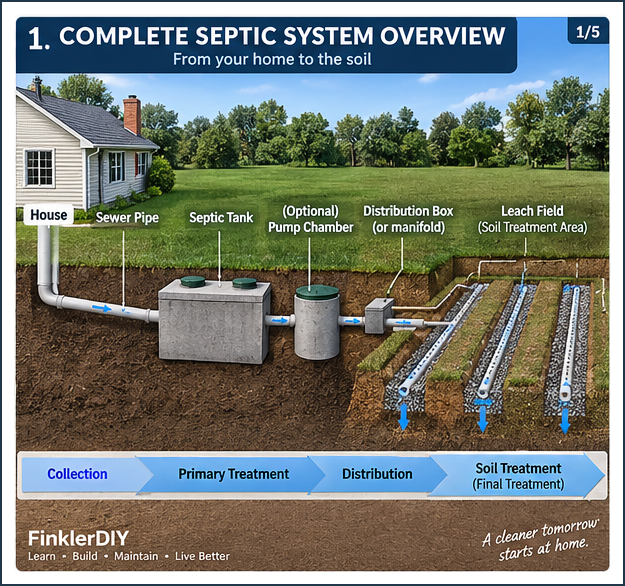
A septic system is essentially a small wastewater treatment system located on your own property. Instead of sending sewage through municipal pipes to a large treatment plant, wastewater from the house enters an onsite system where solids are separated, liquid wastewater is treated and the remaining effluent is eventually dispersed into suitable soil.
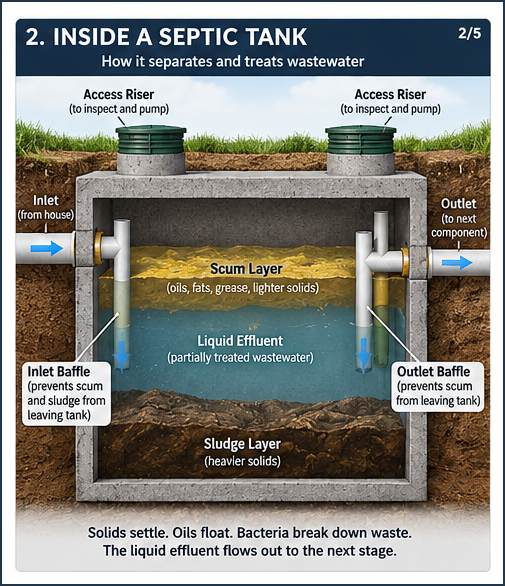
In most systems, everything begins with the septic tank. The tank is a buried, watertight container usually made from concrete, fiberglass or plastic. Wastewater enters from the house and remains in the tank long enough for heavier material to settle to the bottom while oils, grease and other lighter material rise toward the surface.
This creates three general layers inside the tank. A sludge layer forms along the bottom, relatively clear liquid known as effluent occupies much of the middle, and a floating scum layer forms near the top. Baffles or similar fittings near the inlet and outlet help prevent the floating and settled material from simply flowing straight out of the tank.
There is some biological treatment happening in there as microorganisms break down organic material, but a septic tank is not a complete sewage treatment plant by itself. Its most important job is separation. The tank holds back the material that you do not want entering and eventually clogging the next—and arguably most important—part of the system.
The Septic Tank Is Only Half the Story
One of the biggest misconceptions about septic systems is that the septic tank somehow cleans the wastewater and then makes it disappear. In reality, the tank is only the beginning. Once liquid effluent leaves the tank, it still needs additional treatment and a safe place to go.
That is normally the job of the drain field, also commonly called a leach field or leaching bed. Effluent is distributed through underground piping, chambers or another dispersal system and gradually moves into the surrounding soil. As it travels through unsaturated soil, physical filtration and biological activity help remove or neutralize contaminants before the water eventually moves deeper into the ground.
This is why soil conditions matter so much. A property with deep, suitable soil and plenty of room may be able to use an extremely simple septic system. Another property with shallow bedrock, heavy soil or a high groundwater table may need pumps, imported sand, additional treatment equipment or an entirely different design.
The U.S. Environmental Protection Agency lists numerous conventional and alternative septic technologies, and even two neighbouring properties can require different systems because of soil, slope, lot size, household use and local regulations.
So when somebody says they have a “different kind of septic tank,” the tank itself may not actually be the biggest difference. What often changes dramatically is what happens to the effluent after it leaves the tank.
1. Conventional Gravity Septic Systems
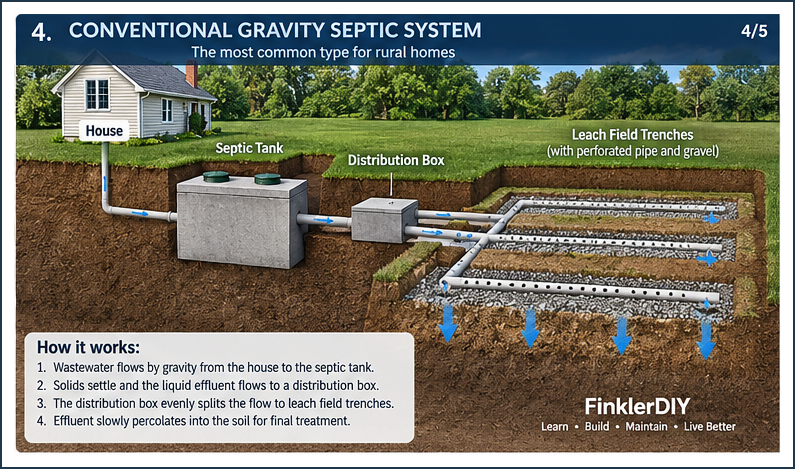
The conventional gravity system is probably the easiest type to understand. Wastewater travels from the house into the septic tank, solids settle out, and liquid effluent flows from the tank toward a distribution box. From there, the distribution box divides the effluent among several underground leach-field trenches.
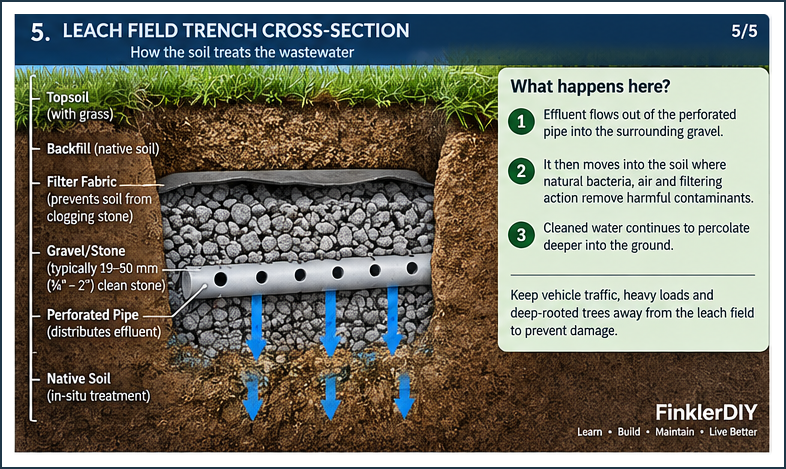
Inside those trenches, perforated piping is traditionally surrounded by clean gravel or stone. Effluent leaves the holes in the pipe, moves through the gravel and gradually infiltrates the soil underneath. Rather than having a pump forcing wastewater through the system, gravity does most of the work.
That simplicity is a major advantage. There are fewer motors, electrical controls, alarm circuits and moving components to fail. A properly designed gravity system on a suitable site can be remarkably straightforward, which is one reason conventional systems have been used for decades.
The catch is contained in the words suitable site. Gravity systems need the property to cooperate. The soil must be capable of accepting and treating the effluent, there needs to be adequate separation from groundwater and bedrock, and the layout needs to allow wastewater to move where it is supposed to go.
If those conditions exist, there is little reason to add complexity simply for the sake of having a more advanced system.
2. Pumped and Pressure-Dosed Septic Systems
Now imagine that the ideal leach field is uphill from the septic tank or that the wastewater needs to be distributed more deliberately across the entire field. Gravity alone may no longer be enough. A pump chamber can solve that problem.
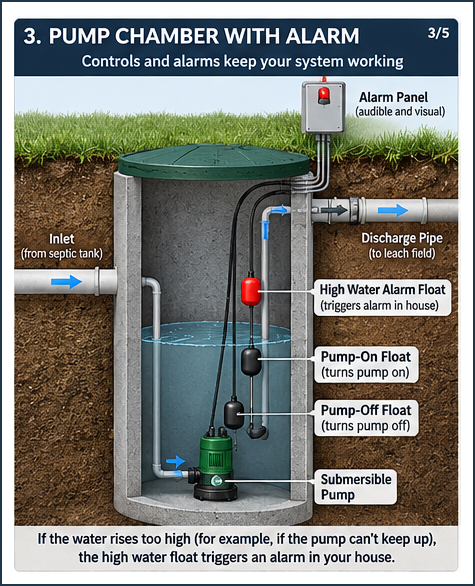
After the septic tank has separated the solids, effluent enters a second compartment or separate pump chamber. The liquid level gradually rises until it reaches a float switch. That switch turns on an effluent pump, which sends wastewater through a discharge pipe toward the leach field.
Some systems use pressure distribution so the wastewater is released throughout the field in controlled doses. Instead of continuously allowing effluent to trickle toward the easiest portion of the field, a pump can periodically send a measured volume through pressurized piping. This can help provide more even distribution across the treatment area.
Of course, adding a pump means adding components that can fail. There may be electrical wiring, multiple float switches, a control panel and an alarm. That does not make pressure-dosed systems bad; it simply means the homeowner needs to understand that the system is no longer entirely passive.
What Is That Septic Alarm Actually Telling You?
If your house has a septic alarm, pay attention to it. A common misconception is that the alarm means there is not enough water in the system. In many pumped systems, the important alarm is actually warning you about the opposite problem: the liquid in the pump chamber has risen too high.
A typical pump chamber may have separate controls for turning the pump on, turning it off and activating a high-water alarm. If the pump fails, loses power, becomes obstructed or simply cannot move effluent as quickly as it is entering the chamber, the level can continue rising until the alarm float is triggered. Alternative systems containing pumps and electrical components generally require more frequent inspection than simple gravity systems.
An alarm does not necessarily mean sewage is about to erupt across the lawn, but it also should not be ignored. Reducing water use until you determine what happened can help avoid adding even more wastewater to an already high chamber.
3. Raised and Mound Septic Systems
A large grassy mound in somebody’s yard can look strange if you do not know what it is. It may actually be part of the septic system.
Mound systems are commonly used where there is not enough suitable natural soil between the surface and a limiting condition such as shallow bedrock or a high groundwater table. Instead of placing the entire treatment field into the existing soil, a specially constructed mound provides additional treatment depth above the natural grade.
Effluent usually moves from the septic tank into a pump chamber and is then dosed into piping within the mound. The mound contains carefully selected sand or other approved material through which the effluent filters before reaching the native soil. In simple terms, if the property does not naturally provide enough appropriate treatment soil, the system creates some of that treatment environment above ground.
That capability comes at a cost. A mound takes up significant space, changes the appearance of the property and normally requires pumping equipment. It is more complicated than a basic gravity field, but dismissing a mound as an inferior system misses the point. It exists because the alternative may be putting a conventional drain field somewhere the soil cannot safely handle it.
That is an important theme throughout septic design: more complicated does not necessarily mean better, and simpler does not necessarily mean better. The right system is the one that matches the site.
4. Chamber Septic Systems
Traditional drain fields often use perforated piping surrounded by a large amount of gravel. Chamber systems approach the dispersal portion differently.
Instead of filling the entire trench with stone, installers place connected open-bottom plastic chambers in the ground. Effluent enters these chambers, where it is exposed to the soil along the bottom of the trench and can gradually infiltrate. The chambers provide an open space for wastewater movement without requiring the same traditional gravel-filled trench construction.
This can make installation and transportation easier, especially where suitable stone is expensive or difficult to obtain. The EPA also notes that chamber systems can work well where wastewater flows vary substantially, such as seasonal properties, and they have been widely used as an alternative to conventional gravel drain fields.
The important point is that a chamber system does not eliminate the need for proper soil treatment. The plastic chamber itself is not magically cleaning the wastewater. It is simply another method of distributing effluent and bringing it into contact with the soil below.
That distinction is worth remembering whenever a septic product is marketed as new technology. Ask what part of the treatment process it is actually changing. Sometimes the technology changes the entire treatment process; other times it is primarily a different way of delivering wastewater to the same biological treatment environment.
5. Aerobic Treatment Units
Most conventional septic tanks operate largely under anaerobic conditions, meaning the microorganisms doing much of the decomposition are functioning without added oxygen. An aerobic treatment unit, or ATU, deliberately introduces oxygen into the wastewater.
An air pump or blower supplies oxygen to an aeration chamber, encouraging aerobic microorganisms that can break down organic material more aggressively. The concept is similar to processes used in larger municipal wastewater treatment plants, just scaled down for an individual property. Some aerobic systems include several treatment stages and may include additional settling, recirculation or even disinfection.
Why go through all of that trouble? Because additional treatment can make it possible to manage wastewater in places where a simple conventional system may not be appropriate. Small lots, poor soil conditions, high groundwater or environmentally sensitive locations can sometimes benefit from a higher level of treatment before the effluent reaches its final dispersal area.
The obvious downside is mechanical complexity. Blowers consume electricity, pumps and controls require maintenance, and biological treatment depends on the equipment continuing to operate correctly. An ATU is not something you install and then forget exists for twenty years.
For the right property, however, advanced treatment may be precisely what makes onsite wastewater treatment possible.
There Are Even More Septic Designs
Gravity, pressure-dosed, mound, chamber and aerobic systems cover many of the designs a typical homeowner is likely to encounter, but they are certainly not the complete list. Septic technology has expanded considerably, especially as people build on smaller lots and more challenging properties.
Other systems can include drip distribution, recirculating sand filters, peat or other treatment media, constructed wetlands and various proprietary treatment units. Drip systems, for example, can distribute treated effluent through relatively shallow tubing, while sand-filter systems deliberately pass wastewater through engineered sand before final dispersal. Some larger developments even use cluster systems where several buildings share decentralized wastewater infrastructure.
You do not need to memorize every variation. The easier way to understand any unfamiliar system is to ask four questions:
- Where are the solids being separated?
- Is the effluent moved by gravity or by a pump?
- Does anything treat the wastewater between the tank and the soil?
- How and where does the final effluent enter the soil?
Once you can answer those questions, even an unfamiliar septic system starts making sense.
Which Type of Septic System Is Best?
There really is no universal winner. A conventional gravity system is appealing because of its simplicity, but only when the property can safely support one. Installing the simplest possible system on unsuitable soil is not smart engineering; it is just creating a future problem underground.
Likewise, spending money on an elaborate aerobic treatment system where a conventional field would work perfectly may accomplish little beyond increasing cost and maintenance. Septic design is less about buying the most advanced equipment and more about matching wastewater volume, soil, groundwater, terrain and available space.
This is why responsible septic installation begins with the site, not the catalogue. Soil characteristics, groundwater levels, setbacks, household wastewater demand and local rules can all influence what is permitted and what will actually work. In Ontario, the province describes septic systems as onsite wastewater treatment units and specifically advises rural homeowners that proper operation and maintenance are their responsibility.
For homeowners, that means DIY knowledge is valuable, but designing or replacing an entire septic system is generally not a casual weekend project. Local permitting, inspection and design requirements need to be checked before altering the system.
What Actually Ruins Septic Systems?
Septic systems have a reputation for suddenly failing, but failure often develops gradually. One of the most damaging situations is allowing excessive solids to leave the tank and enter the drain field. Once the soil or dispersal area becomes clogged, pumping the septic tank does not magically restore the field.
Water overload can create problems too. A septic system is designed to handle wastewater at a reasonable rate, not an unlimited flood. Doing several large loads of laundry, taking multiple showers and running other water-intensive appliances within a short period can send a significant hydraulic load through the system.
Homeowners can reduce unnecessary stress on the system by following a handful of basic habits:
- Fix leaking toilets and plumbing fixtures rather than allowing water to run continuously.
- Spread major water use such as laundry across the week when practical.
- Flush human waste and toilet paper rather than wipes, sanitary products or garbage.
- Keep grease, solvents, paints and other inappropriate chemicals out of household drains.
- Keep vehicles, buildings and other heavy loads off the drain field.
- Avoid planting deep-rooted trees directly over or beside critical septic components.
- Know where your tank, access lids, pump chamber and drain field are located.
None of these habits is particularly exciting, but septic maintenance generally rewards boring behaviour.
How Often Should a Septic Tank Be Pumped?
There is no single pumping interval that fits every household. Tank size, number of occupants, water consumption and the amount of solids entering the system all matter. A couple living in a house with a large tank may accumulate sludge at a very different rate from a family of six using a smaller system.
As a broad guideline, the EPA recommends household septic systems be inspected roughly every one to three years and says septic tanks are commonly pumped every three to five years. Systems with pumps, electrical float switches or other mechanical components may require more frequent inspection.
The smarter approach is to understand your particular system instead of treating “every five years” as an automatic rule. A septic professional can inspect the sludge and scum levels and help establish an appropriate schedule based on how the system is actually being used.
Signs a Septic System May Be in Trouble
A healthy septic system is usually remarkably uneventful. Wastewater disappears down the drain, the yard looks normal and there is little reason to think about what is happening underground. Changes from that normal behaviour deserve attention.
Common warning signs include slow drains throughout the house, plumbing that begins gurgling, sewage backing up into fixtures, persistent sewage odours, unusually wet ground near the tank or drain field, and wastewater appearing at the surface. An unusually lush, bright-green and spongy section of grass above a drain field during otherwise dry weather can also indicate wastewater is reaching places it should not.
One slow sink does not automatically mean the septic system has failed; sometimes a clogged sink is simply a clogged sink. The concern increases when several fixtures develop drainage problems at once or when plumbing symptoms are accompanied by conditions outside around the septic system.
And if your system has an alarm, treat that alarm as information rather than an annoyance to be silenced.
The Final Treatment Plant Is Under Your Lawn
The most interesting thing about septic systems is that the giant concrete tank gets most of the attention even though much of the important final treatment happens elsewhere. The tank is essentially the traffic controller: it separates solids and prepares the wastewater for the next stage. The drain field, treatment media and surrounding soil are what finish much of the job.
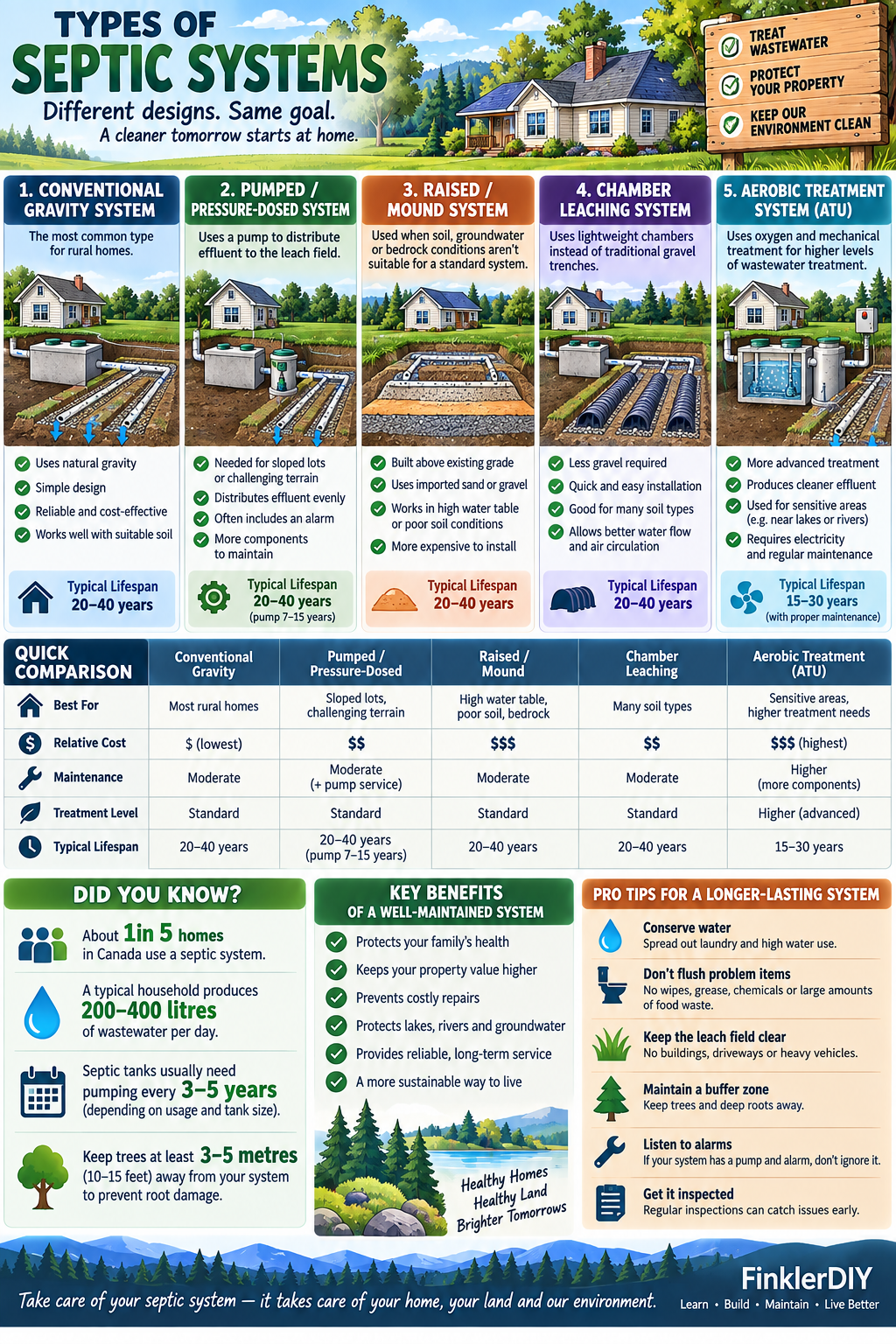
Once you understand that, the different septic designs stop looking like completely unrelated inventions. A conventional system lets gravity send effluent into soil. A pressure-dosed system adds a pump and distributes it more deliberately. A mound creates additional treatment depth where nature did not provide enough. Chambers replace traditional gravel-filled trenches with manufactured dispersal spaces, while aerobic units add oxygen and additional biological treatment before final dispersal.
They are different solutions to the same basic problem: how do you safely handle thousands of litres of household wastewater without a municipal sewer?
Final Verdict: Know What Is Buried in Your Yard
You do not need to become a septic-system designer simply because you own a rural home. You should, however, know what kind of system you have. Find out where the tank is, locate the leach field, determine whether there is a pump chamber, understand what your alarm means and keep whatever records exist from the installation and previous service.
That little bit of knowledge changes septic ownership completely. Instead of an unknown concrete box buried somewhere in the yard, you begin to see the system as a chain of relatively understandable components, each performing one specific job. And when something does go wrong, you are much better equipped to recognize what is happening before a minor problem becomes an expensive one.
A septic system should be almost boring when it is working correctly. Wastewater enters, solids remain behind, effluent receives additional treatment and the soil quietly finishes the process. Whether that happens through a simple gravity field, a pump, a raised mound, plastic chambers or an aerobic treatment unit depends largely on the property underneath your feet.
The technology may differ, but the objective never changes: safely treating household wastewater while protecting the home, the surrounding land and the water beneath it.